Advanced copies of my book arrived

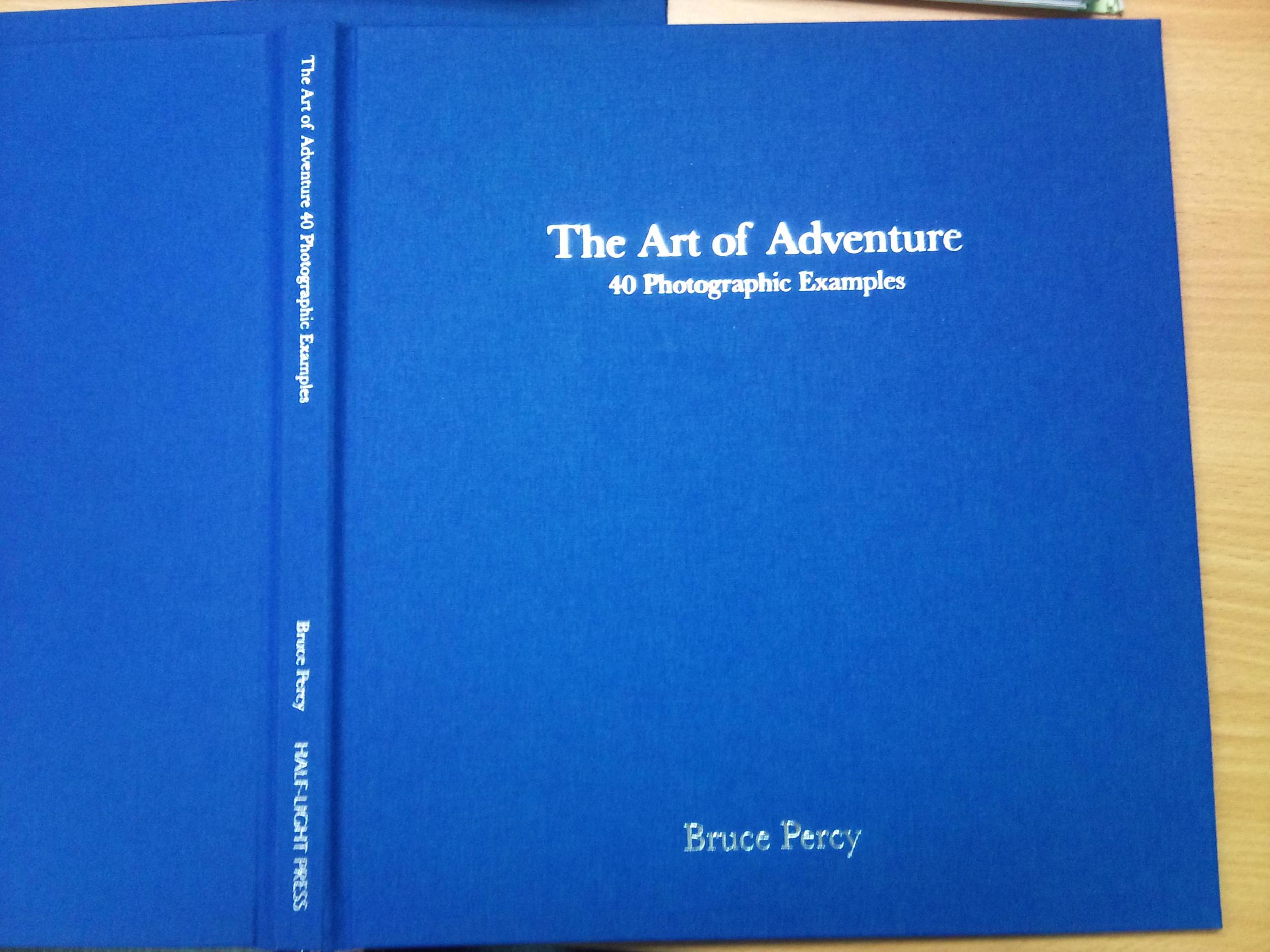
Yesterday I received four advanced copies of my book. I just thought I'd write a short post today to tell you all that the book printing quality has far exceeded my expectations.

I've heard so many scary stories of people having trouble with printers and the book quality not matching what they were looking for. I'm now of the opinion this is perhaps due to one of two reasons:

1) The photographer did not have a colour managed system

2) The printer is old-school and is not colour managed either

My printer is well regarded for making high end art books and their process conforms to the FOGRA ISO standard. The proofs I received were very accurate - matching what I saw on my calibrated system at home, and the final books match the proofs, but exceed in terms of final paper and contrast quality.

The book is going to be photographed this week, so I will post some images as soon as I have some to show you.

Edward Burtynsky - Manufactured Landscapes

Many years ago, when I first decided to venture out there, and conduct my first photographic workshop, I set it up in Torres del Paine national park in Chilean patagonia. My clients included two Canadians who spent their time talking to me about many photographers. One of their idols was Edward Burtynsky. I'll admit that at that point in my photography, I'd never heard of him.

But the world is full of talented individuals.

After the workshop, I parted company with my Canadian clients, and went home for a long earned rest. A few weeks passed, and one morning the door bell rang. The post man stood outside my door holding a large cardboard carton. I took it inside and wondered what might be inside. Upon opening the box, I found a copy of 'Manufactured Landscapes' but Edward Burtynsky. It had been sent to me by my Canadian clients, I'm sure, as a response to our conversations during the Patagonian workshop. The gesture blew me away because I realised that what we had been discussing during the trip had resonated with them in such a way that they felt inclined to send me a copy of one of Canada's most prominent photographers.

Also included inside the box, was a copy of Pico Iyer's short story about visiting Iceland. I had discussed Iceland with my Canadian clients, and in particular - Mary, had felt a connection with my stories of the country, and the short story of Iceland by Iyer, and had decided to include a photocopy of the story for me. It was a great read and it reminded me very much of my first time visiting Iceland in 2004 (I now own a copy of Pico Iyer's book of short stories about his travels - thanks to Mary).

Anyway, I digress. I'd been sent a present! And that present was the result of some engaging conversations during the workshop in Patagonia.

I wasn't familiar with Burtynsky's work, but when I looked through the finely printed coffee table book, I became very engaged in what I saw. I had no reason to read the text, because contained within the pages were high detail (large format) photographs of mass-scale ecological production / waste management throughout the world. I had simply no idea, for instance, that there exists rivers of molten steal, landscapes of worn out tires, sky rise blocks of mined chalk, all consumables, all on a mass scale, all which could be easily interpreted as some normal landscape, until I looked a little closer and realised that this was all the product of a race that consumes and discards with little or no thought for the finite resources of the planet. Burtynsky was spelling out mass-scale environmental issues simply by using his large format camera to capture the finer details in a massive landscape of consumable, or discarded, material.

This week I dug out Manufactured landscape by Burtynsky. It is an absorbing volume. A large scale coffee table book, beautifully printed, the cover gives the illusion of a natural landscape (I thought lava flows, only to discover that it is a man-made landscape of molten steal)... sometimes we need to look at industrialisation in its rawest form. Landscape photography is not just about capturing the essence of natural beauty in the word, it can also be a valid way of throwing up a mirror and exposing ourselves to who we really are, and how we treat our environment.

Highly recommended.

You can, of course, get it from Beyond Words here.

Foil Stamp

I'm just home from my Eigg workshop. Today I got some news from my book printer. So here is a little glimpse of the cloth cover of my forthcoming book. Printer will be sending me some advanced copies in a week or so. More concrete news to follow.

The Eigg workshop went very well, despite us having to leave a day early because the wind had kicked up so much we may have not got off the island today. The food at the B&B was as usual fantastic and the group I had with me were great fun. I have a few stories to tell from this trip and I hope to post some information about one of my participants who owns a camera rental outfit in Chicago called ProGear. Doug Sperling showed us some phase-one images and discussed some very interesting aspects such as lens choice. It seems that the tonal range captured by the phase one backs can be significantly affected by the type of lens you put in front of the sensor and we saw some images were highlights were lost using one lens and restored using another.

I think the highlight for me this week was forgetting my head torch, and myself and John, who is from Egypt had to walk down the single track road in complete darkness to our cottage. I have to say it was absolute black as we didn't find our eyes adjusted to the night. I thought I could gauge where to put my feet by listening to them on the tarmac. I failed miserably and managed to walk right off the road a few times and into some thorns. Ouch.

Still, I find the life I lead these days a very surprising one. If someone had told me I would be on an island trying to navigate in absolute darkness with an Egyptian client at 11pm a few years ago, I don't think I would have believed it.

Anyway, digressing a little here, I expect an announcement about the release of the book in a couple of weeks. I should have some advanced copies end of September to show you all.

Intermission

I'm away to the isle of Eigg to do a workshop this week. Service will be resumed once I'm back. in the meantime, enjoy this intermission.

Electric Counterpoint

Every now and then on this blog, I like to write about something that gives me inspiration, that is not perhaps directly connected to the world of photography.

I'm a huge Steve Reich fan. For those of you who do not know him, he is an avant-garde musician who specialises in syncopated rhythms, always using an orchestra to play his music. Two of his pieces stand out for me; Music for 18 musicians and Electric Counterpoint.

The above video is Royksopp's reinterpretation of Electric Counterpoint by Reich. But if you want to hear something more true to Reich then listen to this video:

If you're into listening to something that is hypnotic, something you can let float around in the background while you get on with something else, then look it up on Spotify and try it out. It's not for everyone.

For me, the music seems to feed a part of my brain that needs to have order and rhythm. Sometimes when I want to listen to music, I don't really want to hear a song, or melody, I'm just looking for sound and something that will fill the space between silence and my conscious thoughts.

Inspiration should come from anywhere. A story, a piece of poetry, a song, a joke, a piece of syncopated music. Anything.

I find there are certain things I'm deeply attracted to. They are beautiful but they also have some form of cerebral entertainment that keep my mind company.

To do well in photography, you need to have an inquisitive, receptive mind. I love lots of things for different reasons, but they all connect with that part of me that is passionate about photography. If you love photography, you love the arts. There are no boundaries, so find inspiration in other mediums, it's all out there waiting for you.

Publish your Photography Book

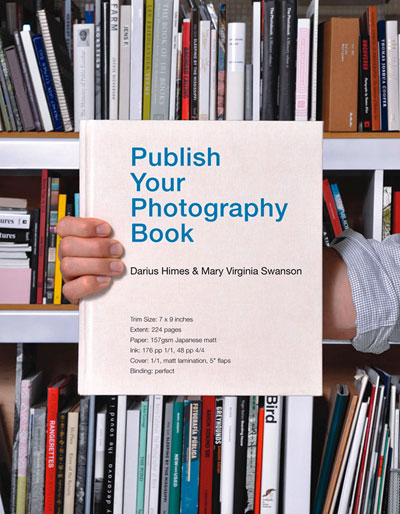
A few weeks ago, Neil from Beyond Words Books gave me a copy of the book 'Publish Your Photography Book' by Darius D Himes & Mary Virginia Swanson. Which I will now refer to as PYPB in this review.

Before you decide that this article is not for you - stop. There is no reason why you shouldn't put your own book together, as I'll explain further down.

I remember thinking 'oh, perfect timing', as he surprised me with it, as I've just finalised the proofs for my own book, paid the remaining amount due to the printer and am now eagerly awaiting some advanced copies of the book.

So yes, I thought the timing of receiving this book was a little off. But perhaps because I've gone through the process of putting my own book together, it's been really interesting reading PYPB. I think there's a lot of useful information in here if you're considering publishing, or getting published because it has plenty of case studies from publishers and also photographers on how their book idea came about and how it moved from being an idea into something real.

I don't think this book would have helped me get published, or help me get round to self publishing - that kind of thing really needs you to have a sense of drive and determination to overcome plenty of odds. What this book does though, is help plant some seeds, make you think more about why you want to publish a book and perhaps the most important question of all: what market the book should be about - who is it aimed at.

In particular, what I found most interesting was that 'best of' books aren't a good idea. Books that sell have a strong theme rather than being a collection of all your best images into one bundle. I can appreciate that this would be true for most photographers that no one has heard of - sure - the photos should speak for themselves, but most people want to know what it is they're buying and why would you want to buy a collection of nice photos from anyone if there's no solid theme or message contained within?

This caused me a little panic at first, since my forthcoming book is more or less a retrospective of images I've shot over the past 10 years. But I soon calmed down when I remembered that I also decided my book should have some form of teaching and message contained within for the reader. Each image has a text that explains the making of and also thought processes I went through. But I also realise that most of the people who will be buying my book, are buying it because they know who I am, and they like my work.

Anyway, if you are considering making your own book - and it doesn't have to be a grand affair - some of the examples discussed started off life as inkjets bound together in to hand made volumes to sell. I think it's a really fascinating thing to do. If you print your images and like to frame them, then putting a hand made book together is no different from this - it is a way of collecting a body of work together and giving a form of closure as well as a final purpose for the work.

There are many book project case studies contained within PYPB to make it an interesting read, simply because of the creative decisions. Everyone is entitled to think about putting a book together - many people do it via Blurb for instance. PYPB helps you think about reasons for publishing, what your market is, and what type of photography book might be the best idea for a project.

Putting a book together is like working on any concept. It's an inspiring adventure and it can also bring a lot of purpose to your photography. If you are suffering from a lack of ideas or direction in your own photography, then I would urge you to consider setting up a project of some kind - and a book is a great way of visualising the final outcome. Having that final goal in mind can do wonders to spur your creativity into action and give you something to get your teeth into.

Above all else, it's a fascinating read as I love to hear about people's creative decisions.

You can get it from Neil's Beyond Words book store.

Harris & Skye

This November I'll be running some workshops in the north west of Scotland. The Isle of Harris and the Isle of Skye. I still have some spaces for these and thought I could perhaps persuade some of you - who have been considering coming on a workshop with me, to come on one of these trips (hey, you can of course come on both if you like!). Each year I always find these trips slow to fill up because, I'm sure, that for most beginner photographers, they think that sunny weather and summer are the best times to take out the camera and make images. It just seems to be the nature of the beast. Also, most amateur photographers believe that Summer is the time for vacation, and winter is the time to board yourself up in the house, beside the fire, and wait it out until the sun comes back in Spring.

Well this is all very well, but most photographers don't realise that the best images are made on the edge of changing weather, and we get a lot of that here in Scotland in the winter time. With one weather front passing over, only to be replaced by another weather front, there is never a dull moment.

I also find that people tend to take mental snap shots of the weather during their working day. If we get up in the rain and go to work in the rain, then we think it's been raining all day. Ever since I started to do the workshops, I've never had a week where the weather is constantly wet or windy. It seems that as the week goes, I forget that we started off with a lot of wet weather and by the end of the week, we've experienced days of sun, cloudy weather, still mornings, windy evenings. It just keeps on changing.

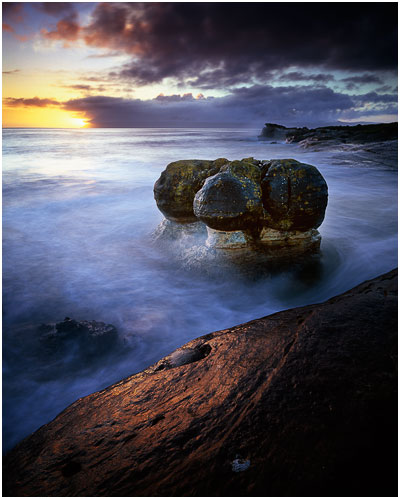
The above four photos were taken this February on my Glencoe weekend workshop. The final day we were outside, the rain kept on coming in. I've seen photographers for years on my workshops want to pack away their cameras and consider the day is finished if the rain comes on. But it's actually a very beautiful time to make images, if we can manage to keep the rain of our graduated filters and front lens elements. Anyway, just look at the moods in the sky I captured. This is only possible when things are changing, and dark clouds are passing through - and this kind of thing doesn't happen on sunny days.

But winter is not just about changing moods on the landscape. Consider this Skye image below, shot last December:

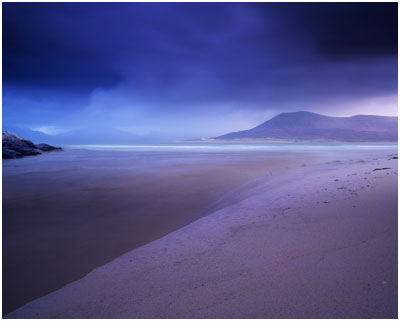
Those magenta tones are very visible in winter time, and mostly never seen in summer. In fact, I often think that summer is full of yellow tones in the sky. Winter on the other hand seems to provide some great textures to pay with in many ways: moving changing light, a low sun with long shadows across the landscape, and also of course fast moving clouds blending and blurring the skies as in this shot here of Horgabost beach on Harris:

So I'm hoping this post has given you some ideas about shooting in winter.

If you have been thinking for a while about coming on a workshop with me at some point, then we're just coming into the best times of the year for shooting great, changing light.

Meeting Mr Kenna

"I met Michael kenna last night.He had the most amazing winkle picker shoes on his feet. Very tall, gangly, warm, eccentric He took the piss out of me, gave me a hug, signed my book

'with admiration' He was extremely rushed off his feet, getting torn in all directions, not wanting to disappoint anyone. I liked him immensely."

Everyone has influences, whether they deny it or not. More so perhaps in the field of arts.

Since the late 80's, I've been a fan of Michael Kenna's photography. It was he, that made me think of an image as being something that could deviate from being a verbatim recording of what was there. His images in the late 80's were often of eerie night scenes that seemed to have a presence that I could not find in anybody else's work.

He has been heavily imitated - which is perhaps the highest form of flattery one can achieve and there are many photographers who would cite him as a core influence.

For the past year, I've had a very nice correspondence with the man I consider to be a huge influence in my own photography. What initially started as a request for advice on approaching galleries, turned into a polite and often fun exchange in email from someone who came across as very young at heart, enthusiastic, and down to earth. It was a delight to find that someone I admired so much, and as busy as he is, could be very humble and open.

Just this week I attended a private gallery exhibition in Zurich - Michael had kindly put a friend of mine and myself on the invitation list.

I had a mission; I wanted to thank Michael for his kindness with a project I've been working on.

When we arrived at the address of the gallery, it seemed to be someone's home. I wasn't sure if we'd got the right address, but a moment later, after pressing the buzzer we were climbing the stairs to what sounded like a party on the 2nd floor.

The gallery seemed to be the owners home and in there, she had around maybe ten of Michael's prints, and also quite a few Elliot Erwitt originals.

The moment we stepped in the door, I could see Michael in the sitting room. It's quite an odd sensation to see someone you know well from photos and books, youtube videos etc etc, and find they're just standing a few feet away from you.

We hovered for perhaps half an hour, waiting for our chance to say  hello to him.

He said 'you made it!' and I just smiled and introduced my friend. I couldn't help notice the massive long, sharp shoes he was wearing. They are perhaps the most exotic shoes I've ever seen on anyone. So I couldn't help comment on them. Michael thanked me and then I said something which came out sounding a bit inappropriate, and Michael didn't let me get away with it. He quickly put his arm around me and said 'what was that? - did I hear you right?'.

Was this true I wondered? Is perhaps my biggest photography hero taking the piss out of me?

Yes, he was, in a good natured way.

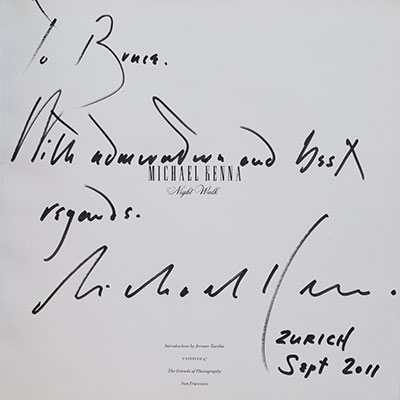
Michael had a young girl with him. She was maybe 10 years old, who we thought was his daughter. He introduced her as his assistant. She was in fact the gallery owners daughter, but he explained to us that she was keeping him right, keeping him organised, reminding him which city he was in.... (his schedule is quite mad) at one point, while I was asking him to sign my copy of 'Night Walk', he asked her - 'hmmmm...... is it Paris today? Hmmm? No? Then, is it Munich? Hmmmm?' to which the little girl shook her head and replied 'no, it's Zurich today'. 'Oh, yes, that's right', he said. And my book was signed 'to Bruce with admiration, best regards, Michael, Zurich 2011'.

There is an old saying 'never meet your heroes', but nothing could be further from the truth in Kenna's case.

I can honestly say that it was a terrific experience for me to meet Michael. He was warm, down to earth, open, really went out of his way to spend some time with me, and he displayed these traits to everyone else in the room with him.

It's so nice to find that not only do you like the work of an artist, but you also find the man behind the work to be a nice chap too.