Workshop Practices: reviewing previous work vs reviewing current work

Before I begin this post today, I wish to make a distinction between workshops and tours. For me, workshops are teaching environments where the primary focus is on giving feedback and teaching people. Making great photos is of secondary importance.

Tours are on the other hand, all about getting participants to great locations, and less about teaching. Although you may learn on tours, this is not the primary objective. They are about getting you round a landscape and taking you to the best places for the best light.

I make this diasctintion, because I feel that many 'tours' masquerade as 'workshops', when  in fact they are tours.

How much work was put into these images? What limitations and obstacles did I encounter? How much post editing was done, and why did I choose to do what I did? All these questions are very hard to ask a participant on a workshop when they show me wo…

How much work was put into these images? What limitations and obstacles did I encounter? How much post editing was done, and why did I choose to do what I did? All these questions are very hard to ask a participant on a workshop when they show me work created elsewhere, at a different moment in time.

Today I was asked by a participant if they should bring along copies of their previous work for review during one of my mentoring workshops here in Scotland.

Over the years that I have been teaching in a mentoring situation, I've found very little merit in looking over what someone did before spending time with me.  Instead, what I find more valuable is to spend time with the participants on the workshop. I'm able to  get a clearer picture of where they are technically and artistically, and more importantly who they are.

I would like to go into in detail today on this post for my reasons why I feel reviews of past work aren't of much value.  I know this may go against the grain for some of you -  particularly with USA clients as I hear bringing along portfolios for review is a common component of many workshops in the states. But if you can bear with me, I'd like to spell out my views on the value of critiquing work created *during* a workshop, rather than relying on work created elsewhere.

In general, I don't find looking over past work to have much value for the following reasons:

There is no audit trail

When I mean 'no audit trail', I mean that it is very hard to get an understanding of what limitations and conditions the images were made under. Why did the participant choose a certain composition and what obstacles did they encounter at the time? If something clashes in the landscape, I do not know if this was noticed at the time of capture but was chosen because it was the only way to make the shot, or if it was chosen because the participant did not notice the error at the time of capture. 

Further to this, in the case of edited (post-processed) work, it is doubly difficult to give advice because the original unedited raw material is not available for comparison.  It's important to see the journey the image made from capture to final edit and if the unedited work is available  I can see what choices were made, or how different the final edit is from the original capture. But this is rarely provided.

Also...

Past images show no indication of current abilities

Indeed, it is often hard when looking at the finished work to get a sense of what the participants abilities were at the time of capture, and more importantly, where they are presently. It is not uncommon for me to be shown images that were made a year or several years previously.

It is however, possible for me to draw up a rudimentary idea of the participants current ability. But only to a point. It is very easy to see if the work is accomplished, but other than that, I am left with a lot of unanswered questions, such as:

1) Was the participant shown the composition or did they choose it themselves?

2) Did they understand the value of the quality of light they shot in, or again, were they shown it?

3) Are these images the best they've made over the past few years? and do they truly represent their current ability? What a participant may think of as important work to show me may not be. I am often surprised to find out that participants have shown me work I have very little to contribute towards, only to find out later there was other work they did not show me which may have provided more value as a critique session.

4) Have these images been reviewed and edited several times before by other workshop leaders? Is what I am seeing now, an amalgamation of other people's ideas? or is this an accurate view of the participants own ideas?

I really have no idea.

So I believe that looking at previous work is of little value. I don't know what choices were made and why they were made. Which leads me on to my next point;

I was not there, I do not know the limitations the participant was under

Giving composition advice of 'if you stood two feel to the left', is invalid because I wasn't there. There may have been a pool of alligators to the left, or something distracting that the participant managed to remove. I do not understand what limitations were placed upon the participant at the time of capture. 

Which is vital to know, as I can gauge what they did and why they did it if I had been there to observe. And observing is a key ingredient of a good workshop leader.

Workshop leaders should be observers

My own view of my job is this:

1) To be able to watch and study my participants and notice how they approach their work

2) To understand how they react to failure

3) To understand how open they are to working with what they are given

4) to understand what their current level of ability is

Point 4 is perhaps the most important because I've had many people downrate themselves only for me to find out they are more competent than they let on. They have talents beyond the scope of any work they may show me from previous outings. On the more negative side, I've had some people talk up what they do and before they begin I'm given a very false idea that they are more accomplished than they turn out to be.

Ultimately, reviews really require an understanding of what motivated the participant, and this can only be drawn upon if I spend time with them in the landscape. Because during this time, I'm able to observe them and notice habits, limitations and aspects of their character that either lend or detract from them making great images.

The value of critiquing present work

Which leads me to why I think turning up at a workshop with a 'clean slate', and getting critiqued on the images you shoot during the workshop is of much better value:

The audit trail exists!

I get to see first-hand what you shot. I get to see the raw data on your memory card. I get a really good picture of what your level of ability is. All this is possible by looking at the images you shoot each day.

Images shot during the workshop show current abilities

I also get to see the most up-to-date impression of your current ability.

I'm able to observe participants and work with them on location

Being there allows me to walk through the process of setting up a shot with the participants, or by stepping in at the last point to see what it is they've set up and to give guidance on what I think can be improved or to point out problems or distractions that they may not have been aware of.

But most importantly, being on location with participants allows me to get more of a direct hands-on feel for what motivates them, and to discuss potential problems at the point of capture, rather than afterwards during the critique sessions when it may be too late.

I was there and I knew the limitations participants were under

Which is kind of similar to the previous point. Simply being there and understanding the weather conditions and physical limitations of a landscape can help me get a better understanding of what was driving the participant to make the images they made.

And lastly.....

I know the person behind the camera

This is perhaps the most important aspect of on-site critiques of current work: during the week I get to know the person behind the camera.

I am able to see how they approach failure, understand their process or notice their good/bad habits. I also get a really good understanding of how much they actually 'see' and what their visual awareness ability is like . Being able to notice these kinds of things about my participants is a skill I believe that all workshop teachers should have.

Being a workshop leader is really about tuning into what each participant is trying to do. There's a fair degree of anticipation involved in trying to work out what each participant is doing and understanding their limitations. It's also about encouraging the participant and trying to be as objective about their work while remaining encouraging.

This can only happen if I am on-site with them, as I get to see them working in the field. It does not happen by reviewing images that were created elsewhere, under circumstances that I am not aware of, or motivations that are now long forgotten or past.

Looking for nuggets

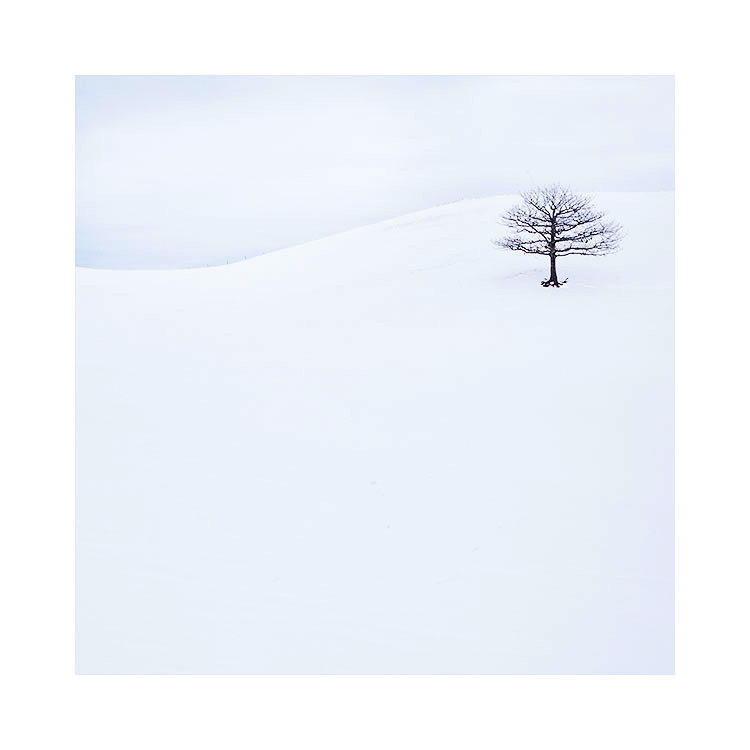
I'm just home from a month away in Norway and just before I left, I had editing my recent Hokkaido work. I only had two days to do the edits before I left for Norway and I knew I had only picked off the obvious contenders for a portfolio before I left.

Now tha I'm back, I have some free time for a few weeks, to review the edits I made, and also to see what I left behind in the pile of over 50 rolls of film I shot whilst in Hokkaido.

It's always interesting revisiting my edits after some time away, and I've noticed some slight luminosity issues in the final work which I have now corrected (but can *you* spot them? Perhaps not, as I think this is the kind of issue that is only apparent to the owner of the work, as perhaps we are often more critical of our work than others would be). 

Lake Kussharo

Lake Kussharo

Looking at some of the remaining transparencies today, it's stuck me that I left a lot of nice images unedited.

Indeed, I often feel that the edit stage should be in iterative process. Just because I have gone through the films a few times during the few days that I concentrated my time on the edit, leaving the work for a further week or so and then coming back to the original images and looking again can yield more images that are worthy of inclusion in my portfolio.

A recently found nugget in my pile of 50 rolls of Velvia.

A recently found nugget in my pile of 50 rolls of Velvia.

I can be too close to the work. Leaving it for a spell allows me to see things in it that I was perhaps blind to at the time of the edit. But it is also worth going back again and again in the coming months and even years to see if there are images that I've missed. What I find uninteresting one day may be interesting to me on another day which can tell me a lot about how my eye is changing and that my skill and perhaps tastes for certain compositions is evolving.

I increasingly feel that photography is a game of awareness. Learning to see what's there that may be hidden in plain sight. It is a constant game of review and reconsideration. Always trying to keep an open mind, always wishing to notice something that I was blind to only a few days ago. Photography is a way of challenging ourselves to opening our eyes, and the more I continue, the more I know that I am only ever seeing a tiny part of what's in front of me.

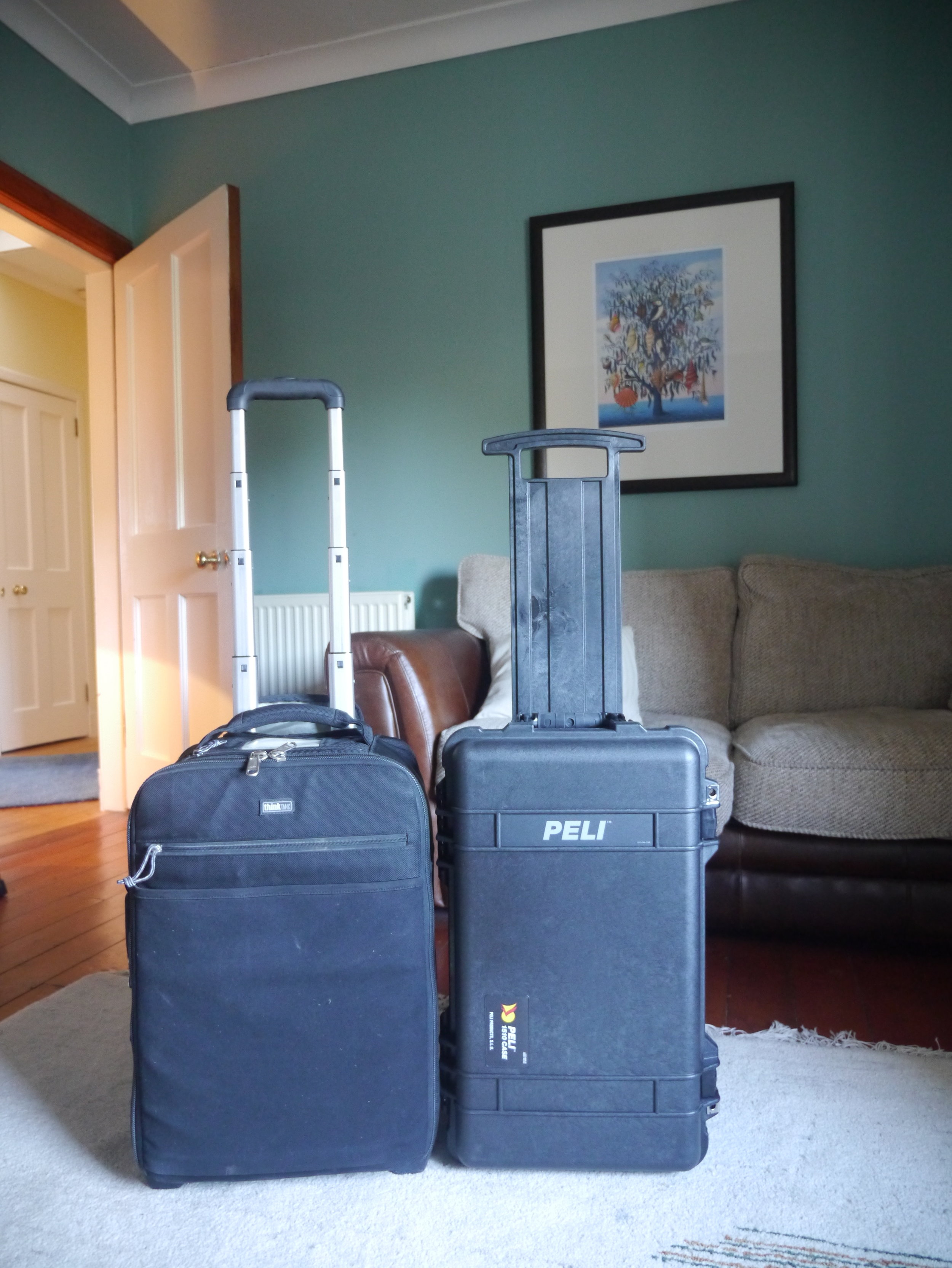
Pelican 1510 case & Think Tank Airport International bags for Airports

I've just bought a Pelican 1510 case for flying. Until now, I have used a variety of 'solution's, none of which has been full-proof when going to airports, as each carrier seems to have their own rules and it is often down to the discretion of the staff I meet at the airport on the day of check in, whether I will have to check-in my bag, or not.

Side by side comparison of both bags.

Side by side comparison of both bags.

The Airport International Think Tank (Left) is wider than the Peli-Case. It allows me to carry more items but the Peli Case is more durable and still allows me to carry most of my items.

The Airport International Think Tank (Left) is wider than the Peli-Case. It allows me to carry more items but the Peli Case is more durable and still allows me to carry most of my items.

I really like the Think Tank bags. They are very durable, tough and well designed and thought out items. I also love my Think Tank Airport International bag, with one exception: it is often 'caught' at check-in. Very often I will see the attendant peer over their desk and say 'pop it on the scales'. Well, even with the bag completely empty it is around 7KG in weight. So I know as soon as this happens that my bag is going into the hold.

One of the solutions I've had for this encounter, is to take out the valuables such as laptops etc, that I think are a high risk of being stolen. I'm also of the opinion that my film cameras are deemed valueless, so I have had very little worry when checking the Think Tank Airport International in. It has happened over ten times now, and on all occasions, everything arrived safely and still in one piece. That's quite comforting to know, as the bag is quite durable, but the top lid is quite soft and wouldn't withstand someone walking over it.

The most recent solution I've had, is to not use this bag at all. I find that if you turn up with a trolley bag that is the full dimensions, it is often weighed. Whereas if I turn up with a backpack no one seems to check the weight of it. My theory is that they assume that if it's on my back, it can't be that heavy.......

But I really dislike backpacks in general, and I also hate lugging them around airports. Plus, they still get stopped from time to time and have to be checked in.

So I've come to the conclusion of late, that it's simply easier if I just check in my camera gear, minus film, minus laptop and minus anything seriously desirable. Which is why this week, I've bought a Pelican case that conforms to carry-on size regulations.

This means that I can still attempt to carry the bag onto the plane, but if they ask to weigh it, and it is now inevitably heading towards the checked-luggage area, then the bag is more robust to withstand knocks and bumps along the way.

In the images above, I show you the new Peli Case alongside the Think Tank Airport International bag I was using. The Think Tank is wider, and also has more space inside. I can get all my equipment plus laptop all in this bag, whereas I really have to squeeze everything to get it into the Peli Case, minus laptop and minus any accessories I had in the lid of the think tank case. To sum it up: the Peli Case works, but it's not as spacious as the Think Tank Airport International. But I think this is Ok, since I am finding that the Airport International is often stopped at check in and quickly becomes something I am hoping will withstand the checked-luggage area of the airport.

I have no firm idea yet whether this is a solution that will work for the long-term, as I haven't tried the Peli Case out as yet. Also, your needs may differ from mine: I travel a lot, and I've been asked repeatedly to check in my Think Tank, plus, I don't think my old film cameras are considered 'valuable' in the eyes of any potential thief. Whereas maybe your sexy new DSLR may be. But I've come to realise over the past four years, that my bag is often checked-in, and I'm becoming more relaxed at doing so, as it has survived so far and nothing has been damaged or broken. Using the Peli-case for the future just seems like the best way forward to securing the success rate that I've had to date at checking my equipment in, but also allow me to try to get the bag on as carry-on as well. We will see.

The three ingredients to composition

Composition is often thought about in terms of where to place the subject within the frame. But what if I throw the subject out of the frame, or at the most, give you a very limited set of subjects to work with? How would you compose your shots, and would you consider how each of them would fit together in a portfolio? What would be the unifying theme if you had to relate them in some way? Is it the subject, the location, or would it perhaps be the colour palette that would be a more useful way of uniting a set of images together?

Subjects are only one aspect of composition. Colour palettes and colour relationships are another, and lastly, there are also tonal responses. My own compositions are often sparse in terms of subject matter, so I think what unifies my work is either the colour palettes I play with, or the tonal responses.

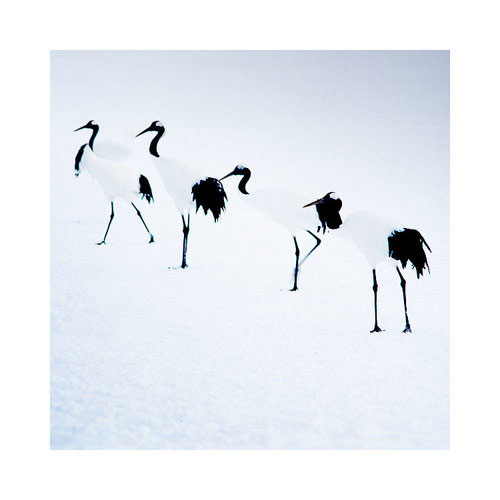
In my latest Hokkaido work, I've deliberately gone for an almost black and 'light blue' tonal response to the work. The absolute blacks of the Crane birds match and unify with the dark tones of the trees of the Hokkaido landscape: this is one part of a two part ingredient list for making this portfolio work. The second part is the colour palette. Despite actually shooting a lot of 'pink sunrise' during my time on the island, I felt they were at odds with some of the stronger 'colder' colour palette images that I found lurking in my processed films. 

I've realised over the past few years just how important tonal responses within a collection of images is to unifying the set. Images are really made up of three dimensions: subject, colour and tone. For me, to think of composition as being about subject only, is to ignore colour and tone at your peril.

This is why I think my work in the Digital Darkroom is a vital ingredient to what I do. Clicking the shutter is only one small part of the image creation process. Identifying themes and relationships in my work is an important part of this process and is crucial in  bringing these themes tighter together.

I didn't capture the landscape, it captured me

Thoughts on impermanence

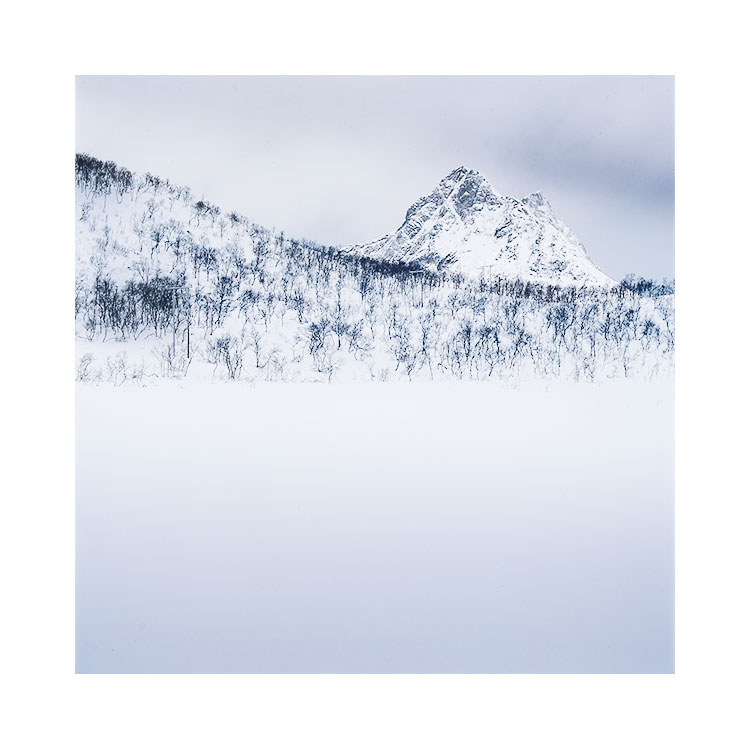
While I've been on the Norwegian island of Senja, I have been thinking a lot about the snowy weather and the wild mountain peaks that surround me.

These mountains have been here for a very long time. They have stood, facing the elements for a duration that I can only begin to imagine, let alone comprehend, and comparatively speaking, I have only been here for the shortest moment of their existence.

Coastal scene, Island of Senja, Norway

Coastal scene, Island of Senja, Norway

This has made me consider my own ideas about permanence, and that I have a tendency to relate to the landscape 'within my own timeline' and  think of it as being part of my story, when in fact I am a tiny part of its story.

The landscape has seen more than I will ever do, it has witnessed and been part of land reforming over many millennia. To think that my images may convey this landscape and 'capture' it is quite a ridiculous notion because the landscape is more powerful and permanent than anything I will ever do, or achieve. The mountains I have walked over and  the rivers I have crossed are a reminder of my own impermanence. It's a humbling thought.

It raises the question about the importance of my photographs and the illusion that my images have some form of permanence: my photographs are just as transient as I am. If I am lucky at best, my images will continue to exist for a little while longer once I am gone.

This has made me wonder if I place too much importance upon my work. I feel that I may have my views on my own work out of proportion to the bigger picture since it is the landscape that has more of a right to permanence than any photograph I will ever create.  

I do not 'capture' the landscape. Instead, it is the landscape that captures me.

The lens points both ways

A good friend of mine just recently said to me 'the lens points both ways' when talking about her work. She was referring to the belief (which I also believe) that photographs tell a lot about the photographer behind their creation.

Indeed, sometimes I meet very talented people who have a good work discipline: they begin things and often keep going to see the work through to completion. I have also met people are are extremely talented, who never finish anything.

And also, I have met people who may not be as talented as the two types of people I refer to above, but they have a strong sense of 'following through' with anything they start. 

This has led me to believe one thing: that being talented isn't enough. There has to be a strong work ethic to pull through and complete what you do and to keep moving forward. Good photography is a combination of ability as well as effort. 

But there also has to be a sense of balance. Working too much and too hard will only cause burn out. Procrastination may be our enemy 'most' of the time, but it is not our enemy 'all' of the time. We do need to have an understanding of when it is time to not do anything, just as much as it is important to know when the time is right to work. Like a music composer who understands which notes to play next, and when to leave a pause in the music, rest as important as the work itself.

As a photographer, do you feel you have a good balance between putting the work in to create your imagery? Do you also feel you know when it is time to rest and go do something else instead? Do you never complete work? Or do you feel you have a strong sense of rhythm to your creative life and feel you know yourself well?

These are important questions, because our creative output (or lack of), often says a lot more about us than we think.

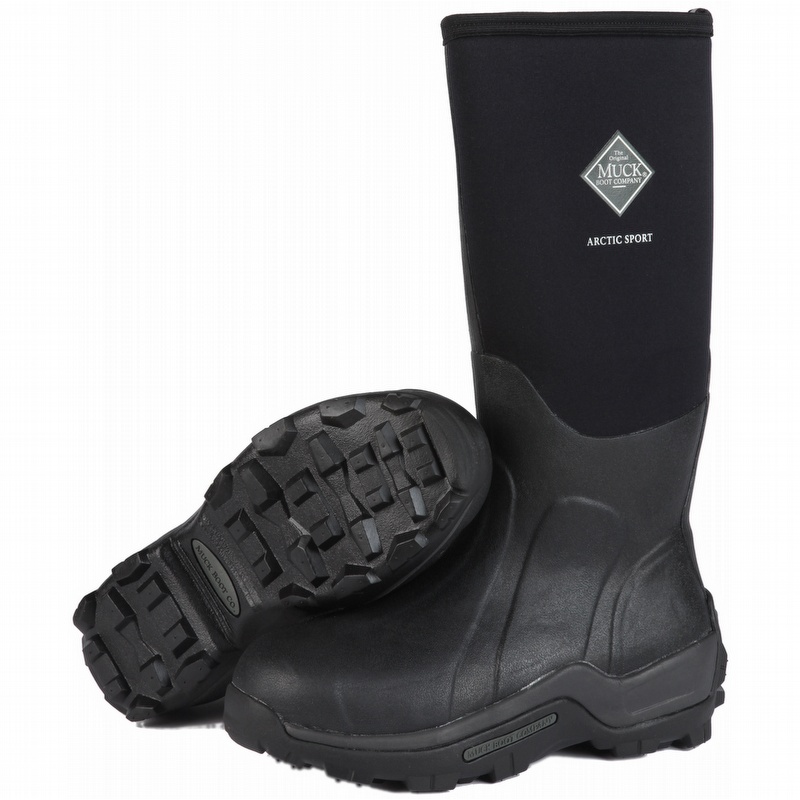
Muck Boot Arctic Sport - The Ultimate Winter Photography Boot

The choice of outdoor clothing we use is just as important as our choice of camera equipment. If I am comfortable, dry and warm while out on location, then this goes a very long way to allowing me to become absorbed by the process of making images.

Muck Boot Arctic Sport. The essential Winter Photography boot!

Muck Boot Arctic Sport. The essential Winter Photography boot!

For many years I have used Scarpa hill walking boots for my outdoor photography pursuits because they give me great ankle support in uneven terrain. They are also made of leather and with the right waxing, are completely waterproof. They are of course a personal choice and just about any outdoor hill walking boot with sturdy ankle support, that is waterproof and has a firm sole (which will not twist and bend when walking over uneven terrain) will suffice for most of what I do.

A year ago, things changed for me. I took a chance and bought a pair of Muckboot 'Arctic Sport' boots. I have been using them in places where there is lots of snow or water. They are like a wellington boot on steroids with thermal insulation, a rigid sole and they are absolutely waterproof to just below my knees. I have found them to be extremely comfortable, warm and dry and I can even wade into water that is more than a foot deep. 

When I bought the Muck Boots, I wasn't sure if they would have sufficient ankle support go give me stability while walking over uneven terrain, or navigating down rocky slopes. I have found them to be sufficient at this, although I do believe that nothing compares to the ankle support that I get from a traditional pair of hill walking leather boots.

The Muck Boot Arctic sport boot has become my favoured boot of choice for most of my photography, and I am now finding that I feel less of a need to take a traditional pair of hill walking boots with me, because I often flood them since they are only waterproof up to my ankle. I think having a boot that allows me to get access to shallow streams and to cross areas where the water is more than a foot deep is very useful.

So I would really definitely think about these boots for winter photography. I am not sure they would be suitable for summer or warmer climes as they are well insulated, so your feet may boil.

One last thing, I have also found that a pair of microspikes has become invaluable for my photography also. It would be easy to assume that micro-spikes are only required for icy conditions but I have found them very useful for slippery rocks and some beach areas where the rocks are slimy. Just this week while on the Lofoten Islands, we had no snow, but everyone was commenting on how secure they felt while using them in areas where the rocks were slippery.

kahtoola microspikes. Essential winter and beach / slippery rocks accessory.

kahtoola microspikes. Essential winter and beach / slippery rocks accessory.

So in a nutshell: if you do a lot of winter and beach photography, the Muck Boot Arctic sport is a very highly recommended boot by me, and I would also suggest you buy a pair of Kahtoola micro spikes and keep them packed *always* in a side pocket of your camera bag.

An Unembellished truth, Hokkaido, January 2017

I often feel that my first images of a new landscape may possess an elusive quality, one that is difficult to recapture on subsequent visits. There is an honesty present, simply because there are no preconceptions to hold on to. Everything is new.

Through repeated visits, this innocence may be replaced by experiences where the initial impressions can often become lost or burried.

Where last year Hokkaido was more about atmosphere and fog, this year I found myself confronted by a more literal representation. 

Hokkaido is a landscape heavily touched by man, and I think by photographing these symmetrically placed trees, I've moved from a point of suggestion to something more unembellished, more truthful.

Not so lonely trees, Hokkaido, Japan.Image © Bruce Percy 2017

Of course, no one of two ways is better. I think suggestion in imagery can be really powerful and this is often where I love to focus my attention on. But my photography doesn't have to be this way all the time. There is still room for a literal point of view, if one feels that what they are seeing is more than enough to convey a strong image.

Rather like the adage 'if it ain't broke, don't fix it', so too is it pointless to heavily manipulate some work if the work is already conveying something strong. 

But for me, this year was simply different. It was a new kind of Hokkaido. And it didn't really warrant nor ask of me to edit it too much.

Challenging our vision through inversion

Recently, I found that I can invert all the colours on my apple laptop via the system preferences*.

It was a fascinating experience for me to go over familiar work of mine and notice new things in the work. All because I was being forced to see it differently through inverting the colour and luminosity.

What was most fascinating for me, was how my perception changed about the work. With some images I was able to see new shapes that had not been apparent upon previous viewings. Other times it was more that I noticed imbalances in the tones between one area of the image to another area. But I also found that sometimes the images just became quite erie in some way. A new mood or feeling was being projected by them.

As a photographer, I'm always looking for ways to see my images anew. The problem with working on images for so long or living with them for a while, is that become invisible. I stop seeing what's really there, and I become blind to potential errors or issues in the work.

Inversion has been a technique used for a long while. When composing, or editing my work, I will sometimes turn the image 180º so that my eye is forced to walk around the image in a different way. Since I am mostly a left-to-right viewer, I find my eye stumbles into things that weren't an obstruction when they were turned the right way up. 

So if you can use rotation to invert an image and see it differently, then why not invert it tonally? 

* To invert the colours or turn your entire screen monochrome, go to System preferences / Accessibility and choose the Display submenu, you will see the choices 'invert colours' and also 'use grayscale'.

The space between us

My father has often pointed out to me, that many of my pursuits or hobbies have been solitary ones. When I was a small kid, I spent a lot of time painting and drawing and much preferred to spend a lot of time on my own. I am to my own admission, a covert introvert. Over my life, I've learned social skills to help me hide the fact that I spend a lot of time looking within, and find the time on my own with my own thoughts something that I really need, and also enjoy.

When I made this photograph of this small volcanic cone in Argentina, I'm sure I tapped into my ability to remain within the scene while at the same time be outside of it. My camera is a great way of giving space between myself and my subjects.

When I made this photograph of this small volcanic cone in Argentina, I'm sure I tapped into my ability to remain within the scene while at the same time be outside of it. My camera is a great way of giving space between myself and my subjects.

Now before you start to think that I'm someone who's not sociable or able to have a conversation with, those that know me probably find me very chatty and outgoing. The reason why I bring this up, apart from to convince you that I am a normally functioning human being, is that I think one of the true skills of a photographer is to be able to be part of something while at the same time remain outside it. Let me explain further.

In order to really see something for what it may present in picture terms, there needs to be a degree of separating ourselves from what it is we are photographing. We need to be able to look at something differently from those around us. Rather than thinking of our potential subject as something of purpose, we are instead looking at it from an aesthetic point of view. There has to be space between us and our subjects for this to happen. But there also has to be a sense of connectedness to our subjects as well.

I think I have, through my own genetic introversion, gained skills at a young age to be part of what was going on around me, while at the same time remain within myself. This skill has allowed me to be able to exist in the external world while also hold onto my own rich inner-life.

I think this is one of the components of most if not all photographers: we have the ability to be part of our surroundings while at the same time, be separate from them. There is no better tool that I can think of other than the camera which allows us to exist in the world, while also at the same time be outside of it. When we pick up a camera, we create space between ourselves and our subjects. We are no longer part of the scene but instead we are outside of it looking in. And I think this is a situation that many of us find comfortable to be in.

Before you assume that my point of view is that all photographers are introverts (this could be true, it may also be false), the point I am really trying to make today, is that making photographs requires an interesting mix of being able to be part of something while at the same time be outside of it.

If you are someone who has a rich inner-life, then you may find that photography has come naturally to you because it allows you to be outside of the situation, while at the same time part of it. But if you are not an introvert, then maybe this experience of being outside of the scene is still an interesting one for you because it is something you don't normally encounter. It's a real luxury to be able to enjoy something in a way that isn't often encountered in our day to day activities.

Either way, the point I am making today, is that for photography to work, we have to have an interesting mix of being able to be part of the scene we are photographing, while at the same time remain outside of it. Cameras allow us to do that, and I think that's one of the reasons why I was drawn to photography in the first place; It satisfies my need to be part of the world, while at the same time remain outside of it all, looking in.