Dalkúr & Þóristíndur

Dalkúr & Þóristíndur are two mountains in the Veiðivötn area of Iceland. Veiðivötn means 'fishing waters or lakes'. It is an immense landscape of black desert that stretches for as far as the eye can see. It´s beautifully stark, one of those places where you become very very quiet the first time you enter. For all around you is abundant space with just very subtle gradual changes in dark grey and sometimes faintly dark brown desert.  If there is colour to be found here, it is in the form of iron ore brush strokes, often highlighted on the side of small black volcanic cones that occasionally dot the landscape.

Dalkúr & Þóristíndur are two mountains quite visible from the highland-road - an unsealed track made up of nothing more than tyre tracks from high clearance vehicles that manage to make it out to this place.

I'm not one for shooting towards the light. I call this 'shooting against the light' as it always feels as if the direction of travel of the light photons is against me. This kind of shooting results in extremely contrasty light, which I often find very hard to control during exposure and afterwards in the digital darkroom. But Veiðivötn encourages me to do just that because the sand is so dark that hardly any light reflects back from it. Contrasts are required, otherwise the final negatives may appear to be extremely flat.

With this shot, my photo group and myself made a brave attempt to shoot this while rain fronts were coming in every 10 minutes or so. The rain was obviously coming in our direction because the laws of the universe state that wherever you wish to point your camera, the wind and rain direction will always be lined up to land on your lens! So we had to repeatedly dry the lenses off and hope that some of our captures would not have any rain drops.

But most importantly for me was the need to control the contrasts. This shot was taken at a lull in the intensity of backlighting that was occurring. Sometimes the sun would poke right through the background cloud cover so much that I new there was no point in shooting. From a learning perspective, I should stress that when the light looks good to our eyes, it is often still too extreme in contrast. So I waited until the clouds began to cover the sun up so much that the contrast effect was at its lowest. Although the light may appear less exciting and not worth taking, it is the perfect time to capture something that has good dynamic range on your film or sensor, and still maintain the dramatic impression you felt whilst there.

Stac Pollaidh and Cul Mhor, Loch Bad a Ghaill, Inverpolly, Scotland. 2015. Image © Michael Kenna 2015

Stac Pollaidh and Cul Mhor, Loch Bad a Ghaill, Inverpolly, Scotland. 2015. Image © Michael Kenna 2015

On a side note: last year while I spent a very enjoyable week with Michael Kenna in the landscapes of the north west of Scotland, it was interesting to note that he prefers this kind of light. He is a black and white shooter, which often means he is looking for contrasts. I hadn't appreciated just how much though until I saw one of his images taken of a place I know so well, shot in the early morning with the sun coming up behind the mountain. This location I prefer to shoot when the sun is behind me, while Michael preferred it backlit. Somehow I feel my time with Michael may be the reason why I chose to shoot Dalkúr & Þóristíndur with backlighting. I often feel things are learned by absorption.


Back to my image. I also loved the boulder patch below the mountains. With backlit light they stand out and provide another contrast to the picture. They also provide an elegant arc that is the inverse of the curve of the skyline. 

These boulder patches are few: you can drive for miles and just encounter empty desert and then out of the blue, there's a small boulder patch sitting on its own. This is similar to the Bolivian Altiplano, with both landscapes, perplexing things happen where rocks appear to lie in places with no relation to the surrounding landscape.

Interestingly for me, I find Veiðivötn to be the antithesis of the Bolivian altiplano in terms of colour and tone. Both are vast empty minimal places and they feel like brother and sister to me, only with the Altiplano I'm encouraged to open up the tones and shoot the bright colour landscape, whereas with Veiðivötn, its power is in its shadows and mysterious dark tones. It is a landscape full of suggestion, a place where the mind wishes to peer below the surface, and on each visit there, I feel as though I have yet to scratch below the surface of what is there.

Central Highlands of Iceland

In September I returned to Iceland to conduct a photographic tour in the central highlands of Iceland. It´s a place that has been drawing my interest for the past few years as I´ve made several visits there over the Summer and Autumn months.

Hraybeyjalón,, Central Highlands, 2016Image © Bruce Percy

Hraybeyjalón,, Central Highlands, 2016
Image © Bruce Percy

I think this is a very beautifully stark, exceedingly special place. A jewel amongst jewels in the Icelandic landscape in my opinion, but it is not for everybody. Those that seek to shoot sunsets and sunrises will be mostly disappointed here, because this landscape really doesn't suit that kind of treatment. If one embraces the monochrome aspects of it, then I feel we may be on the right path to not only accurately represent what we saw and felt, but also, to excel at getting the best out of this landscape.

Veiðivötn, Central Highlands, 2016Image © Bruce Percy

Veiðivötn, Central Highlands, 2016
Image © Bruce Percy

The central highlands is abstract. It is a photographer's building site of strange shapes and minimalist tones, and it is also often highly complex.

Being able to see motifs and graphical elements that work well to make a beautiful photograph are often at odds with what the landscape offer. These elements are often suggested, or hidden in a complexity of fractured geology. This I feel, is the skill in photographing this place: to tell a clear and concise story that can be easily read and understood without any overcomplexity.

And what about visiting here? Well, the Fjallabak nature reserve requires delicate handling. although it can be a harsh place - you need to understand and respect that you are dealing with a less adulterated version of nature, it is also a place that requires your respect because it is delicate. It's remoteness and difficulty in getting in here for the general tourist has to a large degree, saved it from being damaged. If you do come, treat it well and understand that it is one of the last true wildernesses that most of us can visit in northern Europe.

Minimalism in the central highlands of Iceland

I'm just back home from Iceland where I've spent the past nine days in the central highlands. It's a fascinating place that I became acquainted with several years ago. This however, has been my first tour here with a group and I, and the group loved it.

Fjallabak Nature reserve, IcelandImage © Steve Semper 2016

Fjallabak Nature reserve, Iceland
Image © Steve Semper 2016

I thought it would be nice to show an image that Steve Semper and myself worked on while on the tour together. I think the attraction for me about this landscape is on three levels:

1. The possibilities of abstraction and graphic elements that can be found here if one really works hard at it.

2. The range of tones from monochromatic landscapes to places where there are extreme colours. This is a landscape that asks to be what it is: it is a highly beautifully stark place, where sometimes there feels as if there is no colour, just different shades of grey.

3. It is a landscape full of compositions and possibilities at every turn in the road, yet most are not 'honey pot' or 'iconic' places. It is a landscape that encourages you to step away from the obvious.

Back to Steve's image. We spent quite some time at this location - a purely arbitrary point for me which I loved simply because of the tonal separation between black sand desert and waters edge. What you see in this photo is actually a black sand bar - a small island of sand poking out from the surface of a lake.

What I love about finding arbitrary places to stop at, is that you never quite know what is there until you get out of the car and start to explore. I feel that choosing one part of this lakeside over another is a process of reduction. We started out with some edges of the lake that felt promising only to find towards the end of the shoot that a particular sand bar held the most promise in terms of graphical shapes to make a pleasing composition from.

Even when we did find this sand bar, we spent quite some time fine-tuning the composition so the edge of the sand bar touched the far left-hand side of the frame. There was further additional parts of the sandbar that if left inside the frame, would have prevented the elegant shape that you see here to stand out. Often I feel that making good images is more about what to leave out rather than what to leave in.

I shot around 40 rolls of film whilst on this trip. It was a real adventure - a real process of discovery and surprise each day and I'm now looking forward to going back next year. In the meantime, it was a pleasure to see other's work come up on their digital camera's live-view features, as it reminded me of how much potential may be lurking inside my films once I get home and have them processed.

Many thanks to Steve Semper for letting me show his image on this blog.

Simple in design: the art of reduction

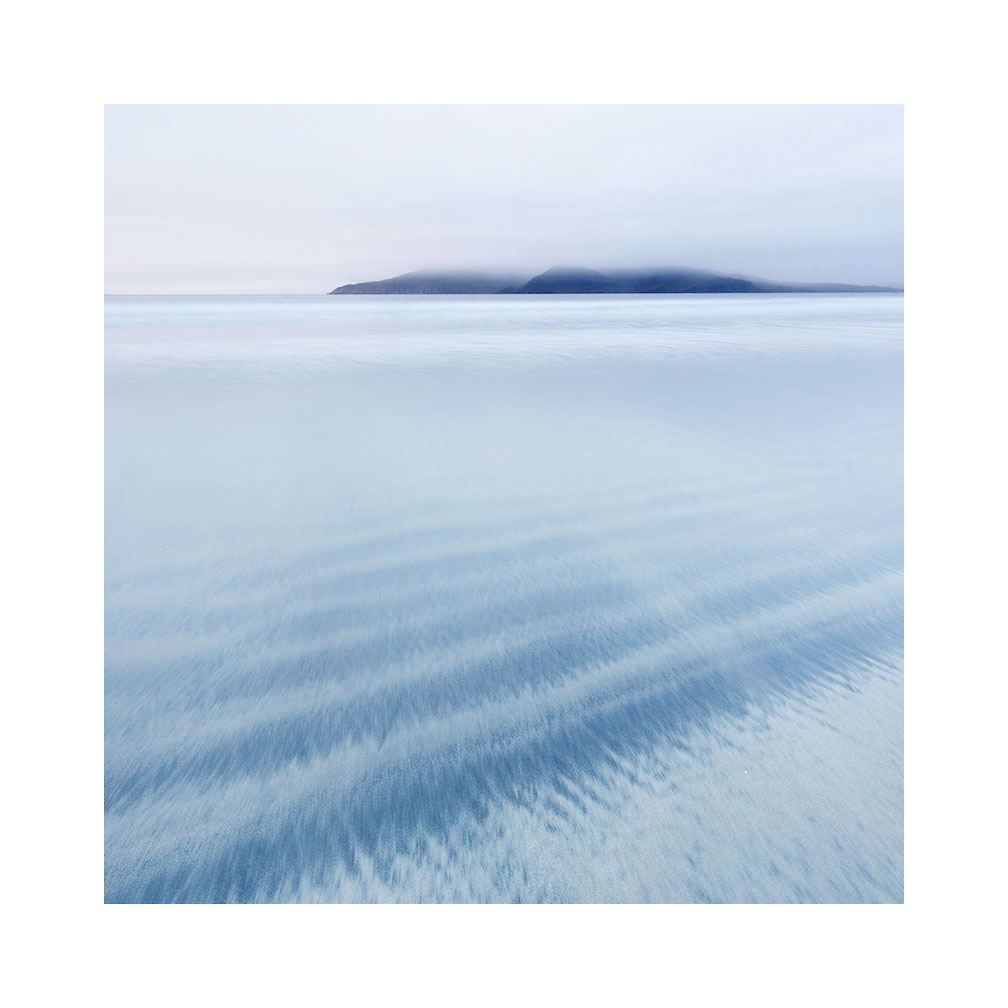
My good friend and client Stacey Williams made this shot on our Eigg workshop last week. I think it's highly atmospheric, effectively simple in composition and tonally very finely balanced. It tells me all I need to know without trying to spell it out either: there are no loud colours or over the top contrasts here, just an inner confidence to show you the beauty of one of Scotland's most photogenic beaches.

Bay of Laig, Isle of Eigg, Scotland.Image © Stacey Williams 2016, post-edit Bruce Percy

Bay of Laig, Isle of Eigg, Scotland.
Image © Stacey Williams 2016, post-edit Bruce Percy

And yet, to pull of a very simple composition like this is not easy for many of us. We struggle with the reduction that's required to distill a scene into one simple message.

I have a theory why this is.

For a long while, I've realised that when most of us start off making pictures, we tend to over complicate them. The final image often has a lot going on and within this complexity is the added dimension of tonal / colour conflicts. Photography is one of the few past-times where we start complex and spend a life-time aiming to make our photographs more effective by simplifying what we put into the frame (or perhaps more importantly, what we choose to leave out).

The reason why we start with overly-complex pictures is because we haven't learned to truly 'see'. Photography is a life-long discipline on being able to really see what is before us and translate that into an effective photograph and if we aren't really aware of tonal conflicts, or distracting objects in the frame, we will tend to leave them in. This is why we can often find our final image doesn't look the way we thought it would. We tend to 'see' differently at the time of capture than the way we 'see' when we look at an image on our computer screen later on.

I've been asking myself for a long while: why this is so? And the only thing I can come up with, is that we tend to look at scenery differently than we do when we look at images. The art behind many successful images is to be able to see the photograph within the scenery while we are on location. Many of us don't do this because we are overwhelmed by the elements of being there, and we still can't abstract a 3D location down into a 2D image.

But composition isn't just about where to place objects within the frame, and choosing what to leave outside of the frame. It is also about understanding the relationships between colours and tones within the scene. In fact, both are interrelated. 

Again, if you aren't able to truly 'see' the relationship between colours and tones within the frame, then the final image may be fraught with overcomplexity. 'I never saw that red telephone box in the corner of the frame', or 'the stone in the foreground is really dark and I can't recover it in post, I wish I'd noticed how dark it was at the time of capture'. This is a typical response because at the time of capture we were too busy thinking about stones rather than the tone or dynamic range of them and whether they would render enough detail in the final picture.

Visual awareness of what is really in front of us, is really at the heart of all of our photographic efforts. If we can't see the tonal distractions or see the conflicting colours at the time of capture, then it means a lot of massaging and coaxing in the edit phase, which isn't a great idea. In sound recording the idea of 'fixing it in the final mix' was always a bad approach and it's better to be aware of the problem at the time of capture and do something about it. If the colours are conflicting, then look for an alternative composition, if the stone is too black to render and will come out as a dark blob in your photo, then maybe go find a rock that is lighter in tone and will render much more easily.

Back to Stacey's picture. She chose a very empty part of the beach. She also chose some very simple foreground sand patterns that she knew were strong enough tonally, to attract interest. She also gave the background island a lot of space. The edit was very simple: we added a lot of contrast to the island to make it the dominant object in the frame, but we did it while doing almost nothing else to the picture because the picture was already working.

If you are struggling with composition, my advice would be to seek out simple empty places and work with one or two subjects within the frame. Add a rock into the picture and experiment with placing it at different areas. Also try rocks of different tonal responses. How would a jet-black rock look in this scene? Will it stand out from the background sand tones? How about a rock that is similar in tone to the beach? Will it stand out just as effectively?

The problem is, that what our eye thinks is pleasing, is often overly complex for our imagery. Good composition is not simply just the act of reducing down the subjects within the frame, but also of understanding which ones will work best tonally as well. Our eye loves more complex objects around us but they don't work when they are all crammed into one picture.

Good landscape composition is not something we master in a matter of weeks or months. It is a life-long journey in building up one's own visual awareness, of noticing what will work, and just as importantly what won't. If you're in it for the long haul, and you have a curious mind, then that's a very good start indeed.


Johanna under the Ice

This is a very beautiful and inspiring short movie. The cimematography is excellent and I was pulled in from the very first frame.

Movies and photography are highly related. If you love photography, you *should* love those kinds of films that are an art-house experience. We can learn a lot from how a film has been shot, not just from the compositional elements, but also from the lighting, colour palette used throughout. This little movie had all those criteria as well as a beautiful story.

Once I'd watched this movie, the lasting impression was that it was in black and white. It was only once I'd watched it a few times that it dawned on me that the entire thing is shot in colour. The use of the black wetsuit against the snow is perhaps the image that stays with me. Even now.

Many thanks to Ming for sending me this link :-)

Resting

Hobby. It's a word that makes light of what we love. When you are 'into' something, it's not often the case that you're 'lightly' into it. The word 'hobby' could and should be replaced by the word 'obsession' for most of of. Don't you agree?

That's certainly the case for me. If and when I get into something, I tend to get into it in a big way. This is in fact how my photography started out - pretty much as a mild interest which in the space of around a year took over most of my free time.

But the thing is, we can't do our hobby all of the time. I know many of you constantly think about photography, are always on the web checking out gear, websites, reviews, portfolios and (hopefully) my blog. But there is a danger in doing this too much: as my dad has said to me on many occasion 'everything in moderation'. It's a good piece of advice, because if you keep spending all your free time on one hobby or passion, you're in danger of killing it for yourself.

My new bike. One of my other 'hobbies' is cycling and also cooking. I'm perhaps not that good at either but I love doing them and they give me a welcome break away from photography.

My new bike. One of my other 'hobbies' is cycling and also cooking. I'm perhaps not that good at either but I love doing them and they give me a welcome break away from photography.

Spend too much time doing one thing, and no matter how much you love it - you're sure to kill it. So it's a very healthy thing to take the foot of the gas every now and then and go do something else instead.

For me, that 'go do something else instead' is cycling (and also cooking). I love cycling and tend to spend every alternate free day I have at home on my bike doing somewhere around 40 miles.

I've just bought a new road bike. It's a Specialised Tarmac comp bike. Most definitely the most exotic bike I've ever owned - it's super light, goes like the wind and helps haul my not so light body up the hills :-)

Still, the reason I mention this is really because I find I need time away from my craft. Everything needs balance.

If you work too much you'll get miserable. If you do too much of one thing, you'll get sick of it. Everyone needs to recharge. Everyone needs a change. But some of us never know when to quit doing something, and will keep going and drive the entire passion/hobby into the ground.

We need to nurture and look after our passions. We need to care for them. One way to do that is to let go every once in a while and go do something else instead. So next time you find yourself feeling frustrated or bored with photography, or if you are questioning whether you're still interested in it any more, this is a sign that you've been doing too much of it and need to give it a break.

We can't spend all of our time doing one thing. So be kind to your creativity and your passion. Know when enough is enough and go do something else instead for a while. It will make the times when you do return to photography much more satisfying.

New e-Book announcement


I'm pleased to announce that today I have released a new e-book - part 1 in a 2 part series:

In this e-book, I aim to give you some thoughts with regards to tone, and its use in photographs to strengthen and weaken relationships between areas in the frame. 

In essence you will learn that subjects may be related to one another through tonal similarities. By ‘tuning’ the tones of one subject to be more similar to the tones of another subject, you can introduce, or strengthen an existing relationship further. 

By using the principles discussed in this ebook selectively during your editing sessions, you can reduce tonal distractions, help emphasise the right areas of the frame and aid in balancing the overall feel of your images. 

The book is split into the following sections:

Section 1 - Tonal Relationship Examples

By giving you some real-world examples of how Bruce chose to edit his work, you will gain a clearer insight into the power of tonal relationships.

Section 2 - Tonal Evaluation Techniques

These Techniques will aid you in developing your own visual awareness of tonal relationship. They also help you in finding areas of conflict in the image and also of correcting / adjusting tonal properties to the right degree.

This one has been a while in the making and  It could only come about because of the work I've done holding my twice-yearly Digital Darkroom workshop. I hope you enjoy it. 

Part 2 isn't far away :-)

Find out more / Buy the e-book

Keeping it simple - the KISS principle

KISS is an acronym for "Keep it simple, Stupid" as a design principle noted by the U.S. Navy in 1960. The KISS principle states that most systems work best if they are kept simple rather than made complicated; therefore simplicity should be a key goal in design and unnecessary complexity should be avoided. - Source Wikipedia

I think keeping things simple is one of the best bits of advice one can get whether it's in your photography, or any other area of your life.

Antarctic Beech, Rio Serrano Forest, Torres del Paine National Park, Chilean Patagonia.Image © Bruce Percy 2016

Antarctic Beech, Rio Serrano Forest, Torres del Paine National Park, Chilean Patagonia.
Image © Bruce Percy 2016

Indeed, keeping things simple is a principle that has over time, been adopted by many disciplines from engineering to the arts to recreational activities. Here is another example of the KISS system taken from Wikipedia:

In film animation, "Master animator Richard Williams explains the KISS principle in his book The Animator's Survival Kit, and Disney's Nine Old Men write about it in Disney Animation: The Illusion of Life, a considerable work of the genre. The problem faced is that inexperienced animators may "over-animate" in their works, that is, a character may move too much and do too much. Williams urges animators to "KISS". - source Wikipedia

I also know that in scuba diving, the KISS principle is employed with rebreathers. The belief is that by making the rebreather fully manual, it's more likely that the operator will have a complete idea of what is happening  at all times. This I understand, was due to many deaths from divers using automatic rebreathers that fail. It's a simple idea: make the user fully in control and that way there's less chance for things to go unnoticed.

I have a few KISS principles regarding my own photography. I don't suppose I'm the only one who does and each of us will have different approaches to our own working methods.

With regards to my digital-darkroom working methods, I prefer to keep things as simple as I can. I don't use multiple applications - I just use one and even with the application I use, I've learned to use around 5% of it. My belief is that by focussing on a restricted tool set, I have had the opportunity to become fully fluent with it, so much so, that it has become second nature to me, and my understanding of it has deepened over the years.

If I feel there is something I can't do with my current toolset, then I may enquire elsewhere.  But so far after 16 years, I've not felt the need to. In other words, I only employ new tools or techniques when the situation requires it. Rather than being let loose in a candy store, I prefer to work with what I know.

The same for my choice of lenses. For the first decade I only really used two lenses: a wide angle and a standard lens. Both were fixed focal length lenses. Because they were fixed, I got used to how they rendered scenes and what their technical limitations were (close focussing distance, depth of field range), because they only did one thing. By using only these two lenses, I was able to pay more attention to practicing my visualisation. It was only after so many years that I started to branch out to other lenses.

I also have a process for my kit. I keep everything in the same place, so I rely on muscle memory. Put something back in the wrong place and spend time hunting for it later on. I've also preferred to use the same tripod head for years because I know it well, rather than be tempted to buy new ones all the time. I'm tempted just as much as anyone else and when I have strayed, I've gotten lost or confused for a period of time while I've settled into using unfamiliar kit. These days I try to adopt new equipment carefully and spend a lot of time getting acquainted with it.

Economy has a lot to offer us as creative individuals. By reducing down to what you most frequently use and discarding the rest, your workflow becomes so easy that there is less of a chance of it hindering you while you are in creative flow. Whereas conversely, if you aren't too careful and keep employing new techniques when you don't need to - your creativity may get bogged down in technical troubles.

The skill is knowing when to look for new techniques and when to leave them well alone. If you feel you're getting on well with what you have, then I would urge you to keep it the way it is. If however you feel you've reached the end of where you can go with the tools you have, then it's time to engage in new tools. Just don't do it when you don't need to, as that is the best way to overcomplicate things when they didn't need any fixing in the first place.

KISS - Keep It Simple ( Stupid :-)

Seeking Balance

We are always striving for balance in our photography. We look for it when we are working with tones, when we are composing and also, in how much time we spend on our craft. I know only too well that sometimes spending too much time on what I do can create an imbalance.

As photographers we are drawn to our passion because deep down we are seeking to find a balance between light and shade. Light and share are our Yin and Yang.

Ataranga Hanga Piko Riata, Easter IslandImage © Bruce Percy 2016

Ataranga Hanga Piko Riata, Easter Island
Image © Bruce Percy 2016

The process of seeking balance is important even though I believe the goal of reaching it is not. It is important because it is the mechanism that allows us to create new work. Without this 'seeking' we would become static and nothing would be produced by us. It is also an impossible thing to achieve because life is fluid and when things are always in a state of change, balance is difficult to keep.

Instead, I see 'seeking balance'  as a journey that allows me to explore and create work along the way. It is in moving and changing between states where our creativity flourishes.

Volcanic fault line, Tongariki, Easter IslandImage © Bruce Percy 2016

Volcanic fault line, Tongariki, Easter Island
Image © Bruce Percy 2016

So I think it's healthy to find there is an ebb and flow in one's work. I have moments when I produce very little and then times when I am very creative.

In considering how seeking balance affects my work, I'm aware that recently I've been moving towards a more monochromatic, less saturated look. But sometimes the work does not suit it and I return once more back to more vivid colours. One could argue that this is me seeking balance in the colour aspects of my work.

I've also become aware that sometimes my images are heading towards brighter tonal ranges and then back towards darker tonal ranges. One could also argue that this is me seeking balance in the tonal aspects of my work.

I've come to realise that this moving and shifting is as if I'm flexing some tonal muscle, getting used to a new range of tones that I've not worked with before.

Image © Bruce Percy 2016

Image © Bruce Percy 2016

I believe that we are always hunting, searching, looking for balance in what we do. Yet seeking balance is not about attaining it, It is really more about the movement from one state to another and how new work comes into being through the changes in us.

Just as Yin cannot exist without Yang, and darkness cannot exist without light, creativity cannot happen without a need to seek balance. Once we understand that the act of seeking balance in our work is really a journey, and not a struggle to overcome our limitations, then we become free as creative people to see where it may lead us.