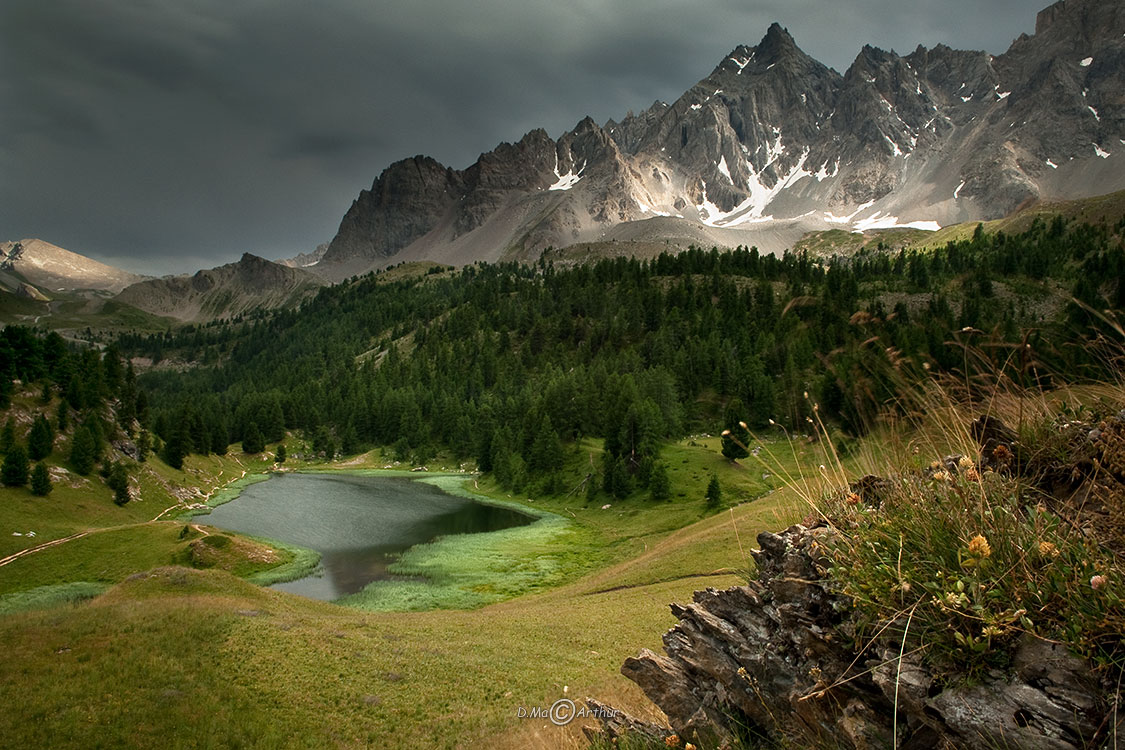
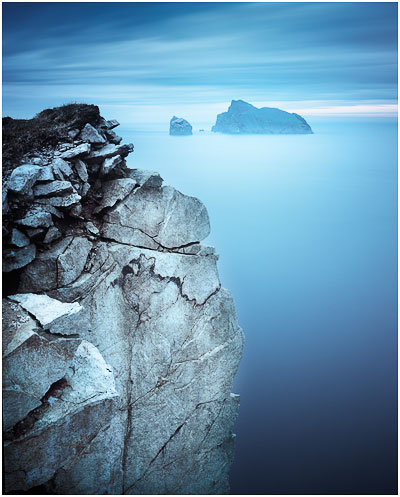
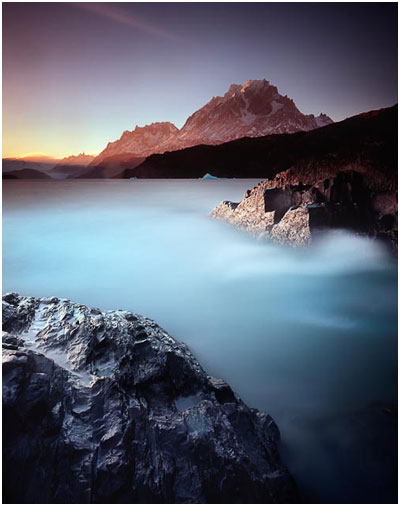
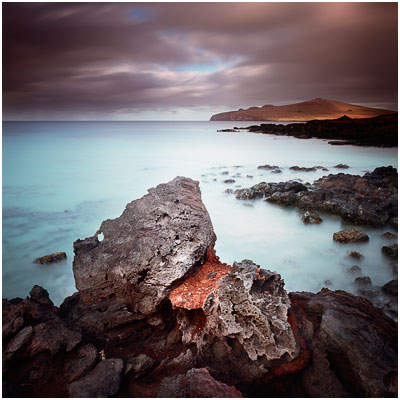
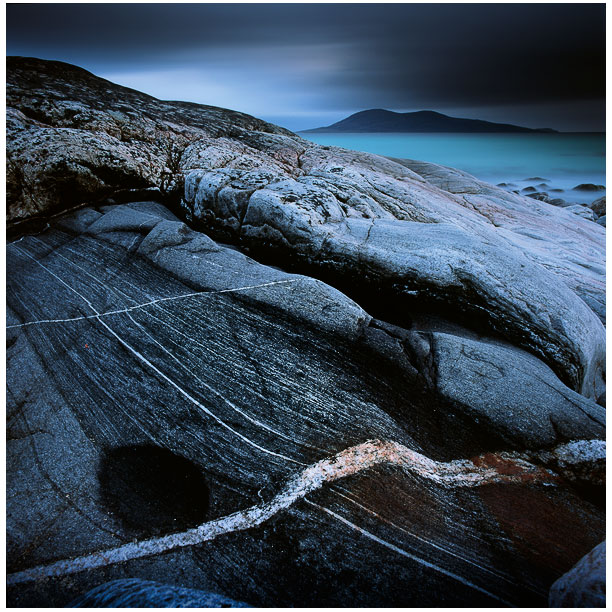
My good friend Duncan MacArthur, is running a workshop this September (8th to 13th) in the French Hautes-Alpes. He's told me today there is only one space left. It's a beautiful part of the world, and I hope some day to get down there to see Duncan on his home territory. Here are some photos of the region by Duncan. If you'd like to find out more, follow this workshop link.
A Meaningful Moment Through a Meaning(less) Process
While I've been editing, selecting and working on the many rolls of processed films from my trips this year, I've been listening to a lot more ambient music.
This has partly been influenced by a friend that I've been sharing music with. And what has come out of this, is that I think the music I listen to, while I am editing and post-processing - going through the selection process, can have a massive influence on how things unfold and evolve during the birth of new images.
I wouldn't for one second assume that the music I've been listening to will be for everyone. But if you like ambient music - things like Brian Eno, Boards of Canada, Ulrich Schnauss, or film music from composers such as Thomas Newman, then you might like this piece of music by Stars of the Lid. I think they produce ambient-classical music :-) It has a floaty, dreamy quality to it that allows my mind to focus on what I'm doing in my digital-dark-room, while also obliterate out the real world for a few hours.
I find that listening to some kinds of music during the editing process can be a terrible distraction. I can't for some reason listen to music with any spoken words in it. It just seems to pull me away from my own thoughts, which isn't good - as I do believe that post editing requires a high-degree of self reflection, and inner dialog.
Highly repetitive music, as well as the floaty/dreamy music mentioned above - does seem to work for me. I think it's because it has a hypnotic element to it - which I believe consumes the part of my conscious mind that can't be quiet. I think repetitive music helps keep this part of my mind occupied, allowing the part of me that has zoned out, to remain in the creative flow that I'm hopefully experiencing.
I have to be aware of my thoughts, which often are only measured by my feelings. If the music is conducive to that, then it tends to help get me into the right creative zone. We all know what that zone is like - it's when we're no longer aware of where we are, of how much time is passing by, and all the distractions of every day life have gone. In that sense, it is very similar to the creative zone we experience when we are out in the landscape - time passes by, thoughts float freely away, and we're left with an empty and calm mind that is ready to be occupied by one thing: the craft of picture making.
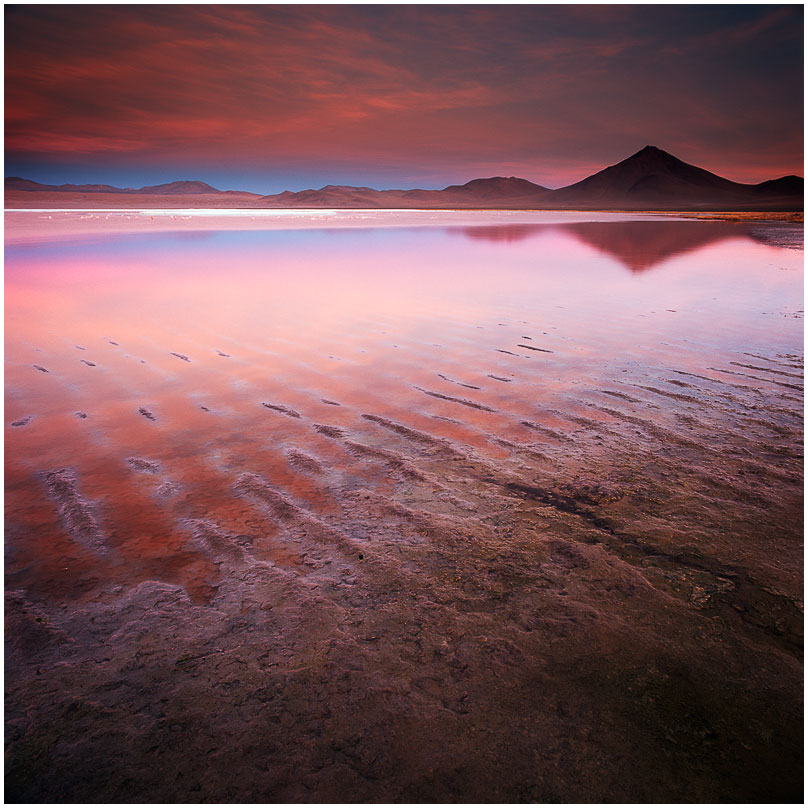
Laguna Colorada, Bolivia
I don't feel like sorting out my images at all from my south america trips. It's kind of nice to just find something I want to work on and scan it.

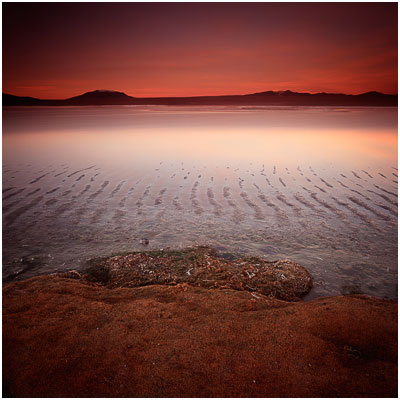
I stumbled upon these lovely images of Laguna Colorada, taken on the Bolivian altiplano. We were all suffering from shortness of breath and it was extremely cold here. But I was so keen to get my group here because each night, the light does something very wonderful to the landscape - I've not really experienced light anywhere else quite like this. Everything goes very red as the sun sets.
The lagoon is famous for displaying a red colour throughout the day when there is wind to stir up the sediments lurking below. But when night falls, the wind tends to go, and the lagoon becomes calm. It is at this time that the rays of the sun seem to be absorbed by the surrounding landscape and the lagoon becomes red again. It's extremely beautiful to witness. There are no pollutants in the sky, the altitude is 4,500 metres (yes, that's not a typo - we're at an extremely high elevation here), and I'm sure this is why the light is so spectacular.
I think next week I may get a bit more strict with myself and sort the images into each 'country project'. As I feel this is the only way to create a unified body of work for each place I've visited. I so often dislike working on images in a piece-meal fashion. Today is an exception, and it's nice to just sift through and decide what I feel I'd like to work on, and perhaps more importantly - relive as I look at the transparencies on my light table, and find my imagination being cast back to a special place at a special time.
St. Kilda
From the main isle Hirta, that makes up the group of islands known as St. Kilda, this images was made looking out towards Boreray, Stac Lee & Stac an Armin.
I visited St. Kilda in May of this year.
Due to the low cloud that would hug the island for days, and the nesting Skua's, we couldn't actually get anywhere much. The wind and low visibility made for an impossible trip to the other side of the island (it's also amazingly very steep). But I think it was the birds that scared me the most. They attack you by diving right towards your field of vision with claws out in front. It's a very menacing pose and a good defence mechanism for keeping predators away from their nests.
Myself and my friend managed to get to this spot however, which isn't far away from the small Historic Scotland camp site (yes, there's a camp site there - shhhhh, I didn't tell you!). There's a very obvious dip that I found. It's not until today that I've noticed it's almost an exact compositional version of Joe Cornish' image (page 72) of his beautiful book 'Scotland's Coast'. I think this is interesting because I'm wondering if the reason I made this was a response to a subconsious memory of his image, or because it's one of the very few opportunities in this area of Hirta to make good compositions? I know for certain that I did not set up to copy - I much prefer to go to a location and find my own interpretation, but sometimes there isn't much of a choice, and certain landscapes dictate 'tripod-hole-syndrome'. So apologies Joe for making a similar shot - it was not my intention :-)
I've wanted to come here for a very long time. It is a fascinating place and my friend Chris had been reading up about the entire history before we got there!
Happy holiday memories (I still have dreams of my scalp sailing away in the claws of a very large bird).
Lago Grey, Patagonia 2012
I've only just dipped my toes into my images from this years Patagonia photo trip. Here is a backlit shot of Lago Grey with Paine Grande cast in an orange glow from a setting sun.

I was initially attracted to the rock in the mid-ground - with it's graphic-angular shape and directional lighting. But it was only while setting the camera up on my tripod that I noticed the lower darker rocks. I felt these could be a great foreground detail with their mottled texture. Often black rocks turn to a muddy mess in a scene, but when there is back lit directional light shining on them, it can help lift their tonal values from extreme black, into the lower mid-grey tones. Making it easier for me to record them on Fuji Velvia.
I made this image on my Mamiya 7 camera. I'm aware that I'm a landscape photographer who feels more at home with portrait-orientated compositions. Perhaps it's the ability to mix a lot of sky in with a lot of foreground that works for my eye. I'm really not sure, but having a mix of aspect ratios to work with has really helped me open up my eyes to the surrounding landscape and consider where each object should be placed.
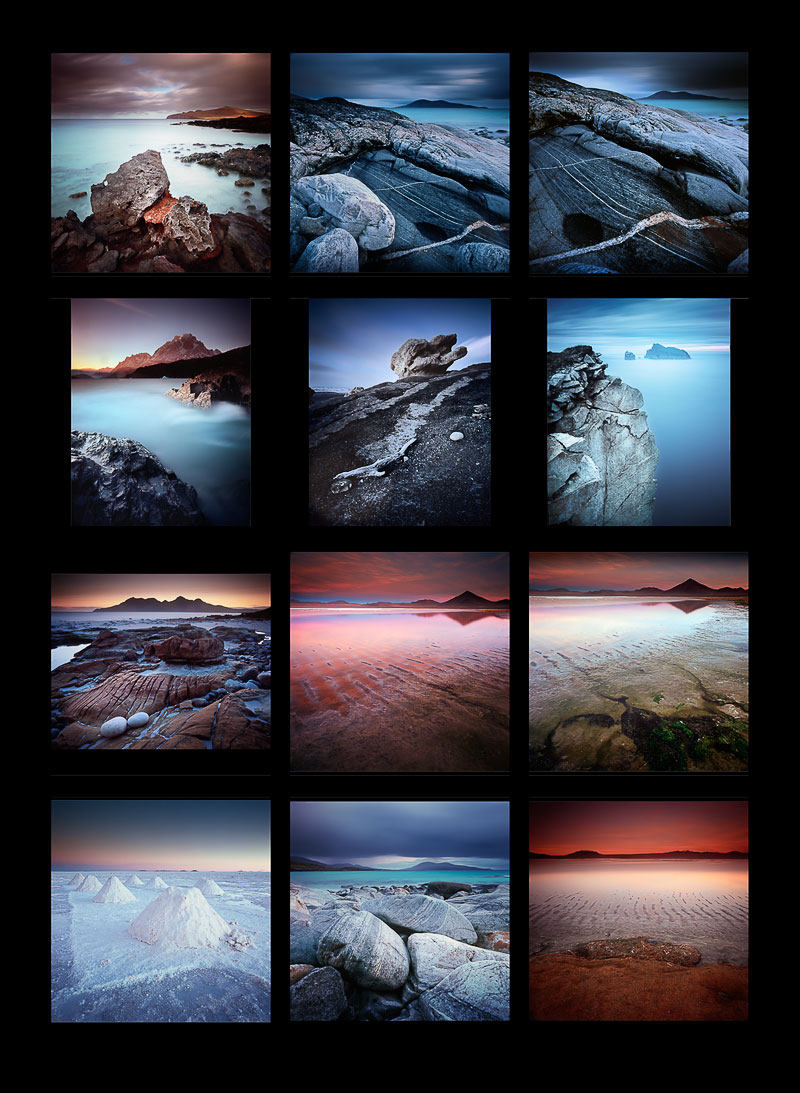
Pockets of colour on Easter Island
I found a bay on Easter Island where the sun wasn't bleaching out the entire landscape.

I used a very long exposure for this shot. Maybe around 2 minutes. Near the end of my trip, I stumbled upon some more great geology. These rocks are volcanic, as is all of the entire landscape of Easter Island. But rarely did I find pockets of red in the stones. I feel the red of the rock has a nice releationship to the golden colours on Poike - one of the triangular points of Easter Island that you can see on the horizon.
Looking for the essence #7
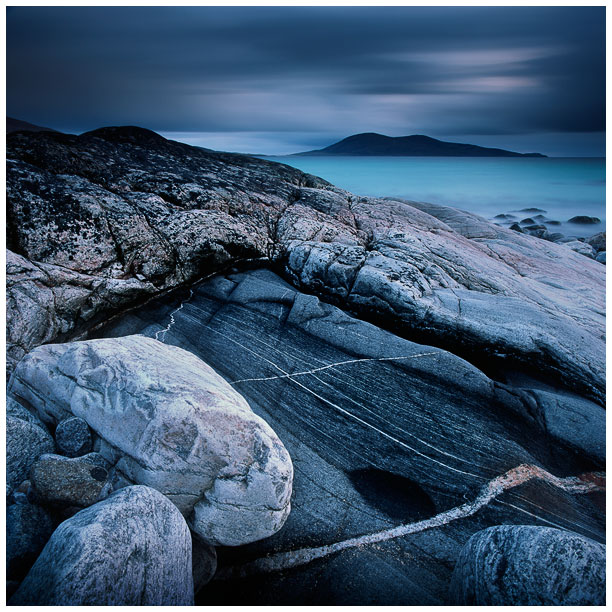
I knew something was there. The weather was closing in and the isle of Taransay on the horizon was often being misted in rain. The light was getting low and my exposures were going down into the 10 minute region (due to reciprocity).
When I encountered this scene on last May's Harris workshop, I spent about an hour or more just in this small location, looking for that elusive 'essence' I've been writing about over the past few weeks. The funny thing is, when I do feel I've reached 'it', and made some shots of it - the scene is often etched into my mind (I shoot film 100% of the time - I'm not a digital shooter, so I have to work with the scene in my mind a bit more than I would if I had a preview screen). I think we need to trust the gut instinct about these things. When you hit upon something that is working, it is as if your entire sensory input is being overloaded. I seem to find everything around me becomes more acute.
Here's an image that was shot in the same area just a few minutes apart.
I should tell you that I found the stones in the bottom left hand corner too distracting and as much as I tried to compose with them in, they never really felt as if they should be part of the composition. I'm often not really aware of what it is that's bothering me when I make images. I just tend to go with listening to how I'm feeling inside. I knew however, that it was the white streak of seam going through the foreground rocks that was pulling me in, and I felt very much that this was the 'essence' of the scene I was trying to capture.
Often we're not close enough.
When I moved to the right to try and extract the white rocks, I found that the dark eye patch seen in the bottom left of the first image became more of a 'motif'. It filled in the bottom left hand side of the frame beautifully. I find that with a bit of fine tuning, moving in closer, moving around just by a foot or two, things can 'snap-into-focus'.
Folded & Gathered
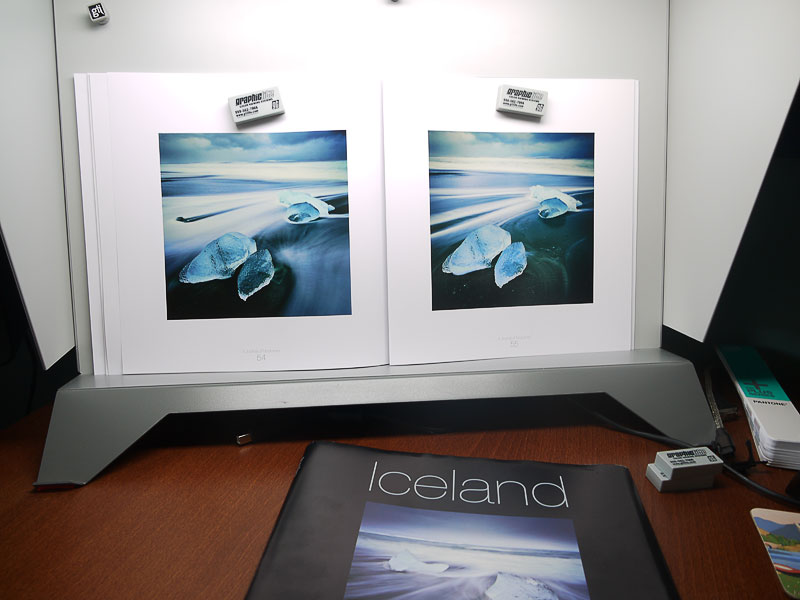
Last week, while I was on the isle of Arran, conducting a photographic workshop, I received the 'folded & gathered' sheets for my Iceland book that will be out in November.

In the above picture you can see two of the actual pages from the book, alongside the dust jacket below.
One of the things you have to get familiar with, if you're getting a book printed, is the terminology that a printer uses. So what does 'folded & gathered' mean?
When the printer prints all the pages of the book, they are gathered and presented in the final order. If you look at a book, the pages are often folded into sub books - my book arrived in a set of five sub-books, where each sub-book contains x number of folded sheets of paper making up the pages.
What is also interesting about this stage is that these pages are the actual 'real' pages of the final book. These are not proofs in that sense, but they still allow me to go back and say I'm not happy with a particular section of the book and ask for some reprints if need be (this is also costly and ads to any possible delays in the book).
It's worth noting that when evaluating the final pages of the book, do it under some daylight balanced light. I used my viewing booth to do that - it gives me great confidence and a 'level playing field' in which to assess whether the reproductions in the book will work in most lighting conditions (yes, any print can vary in how it looks depending on the type of light you view it under).
The whole process of putting a book together is quite an affair. And getting round the terminology that the printing world uses is an interesting experience too.
Glasgow School of Art
I love architecture. Most probably because of the lines and curves, tones and shapes that an architect has to think about when they design beautiful buildings. In my teens, I thought that this was where I would be headed with my interests, but my grades at school were never that good to get me there.
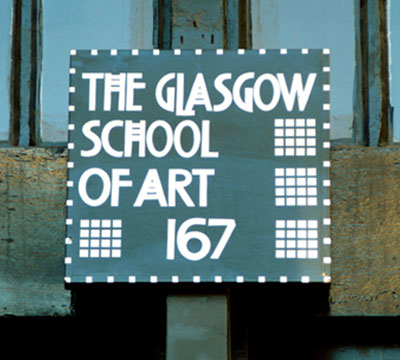
But I love going for a tour of a really beautiful building. Here in Scotland, we're a bit spoiled, because Glasgow is the home of Charles Rennie Mackintosh. He is to Glasgow (and Scotland as a whole), what Gaudi is to Barcelona and Catalonia. He was a genius who built some very beautiful buildings and furniture.
Tomorrow is my day off, and I felt that if I should go somewhere, and do something that gives me inspiration, and a deep sense of satisfaction - I should go and see Charles Rennie Mackintosh's 'school of art'.
The school of art was designed first and foremost as a 'functional' place for art students.
I never went to art-school - which was a surprise for me, because I'd always been a bit of an 'art' kid all through my childhood and teenage years and always assumed this is where I'd end up after high school. I still wonder why I never made it to art school, but I'm willing to accept that maybe I wouldn't be where I am today if I had.
But if I had made it to art-school, I would have preferred to go somewhere where the aesthetic married my own sensibilities and tastes.
Mackintosh's School of art would have been perfect for me. It is a very beautiful building, full of thought and design aesthetics, while also being a place of work - it is filled with contemporary art students.
I love it dearly, and I've visited it several times now.
I think architecture and photography are highly related - both require an awareness of space - as well as of the aesthetic. Both, when done well, can enrich our lives and give us a sense of belonging or 'emotional attachment'.
When was the last time you wandered around a beautiful building, and considered it's symmetry and tonal interest in the same way that you may with the landscape?
As photographers, we are creative people. We get our inspiration from everything around us.
It doesn't have to be visual, but certainly I find beautiful buildings as deeply pleasing (and rewarding) to be around as beautiful landscapes.
I understand the importance of being outside in nature, but I often feel that well designed buildings are our interpretation of nature - they are structured into a tidy, organised way - a way in which we make sense of the randomness of the natural world.
In that sense, beautiful buildings are very much like beautiful landscape photographs. They capture the essence of structure, form and tone of our surroundings.
Sample Slipcase
Last week I received a copy of the prototype slipcase for my book, and also the cloth bound outer casing of the actual Book. The printer hasn't put the inset photo into the slipcase, but you can see the actual book (minus dust jacket) in the front and the slip-case in the background of this photo.

I love the font that Darren chose for the book, and I'm now very excited about the the book's arrival. I should receive four sample copies early september. There will be a special announcement around that time via my newsletter mailing list.
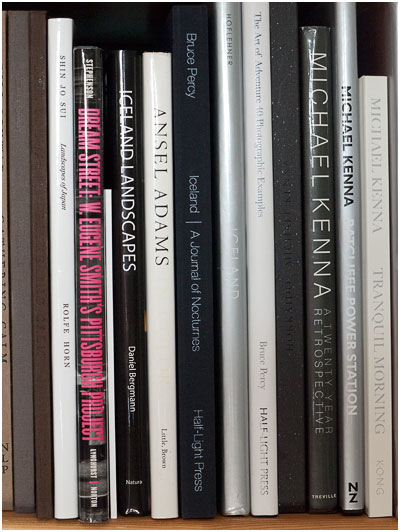
Here's another picture of part of my book collection. Can you spot the new slipcase within these books?