Sample Slipcase

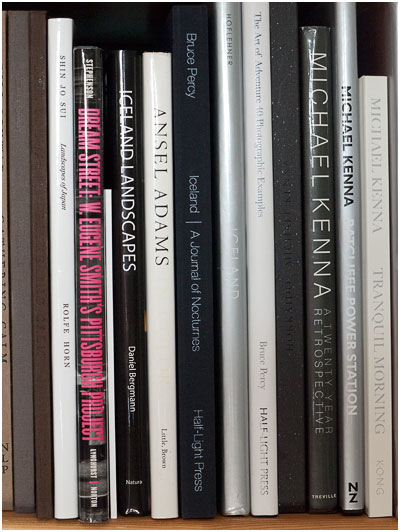
Last week I received a copy of the prototype slipcase for my book, and also the cloth bound outer casing of the actual Book. The printer hasn't put the inset photo into the slipcase, but you can see the actual book (minus dust jacket) in the front and the slip-case in the background of this photo.

I love the font that Darren chose for the book, and I'm now very excited about the the book's arrival. I should receive four sample copies early september. There will be a special announcement around that time via my newsletter mailing list.

Here's another picture of part of my book collection. Can you spot the new slipcase within these books?

Looking for the essence (part 6)

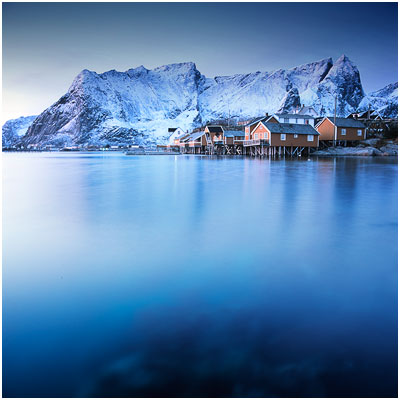
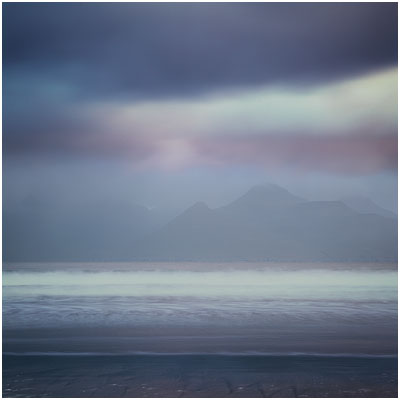
This will be my last post for the next few days, as I'll be on the Isle of Arran tomorrow for a week, conducting a photographic workshop. In the meantime, I thought I'd leave you all with this image that I shot in Lofoten islands, Norway - this March.

I love to shoot during the cusp between night and day, as I often find the light to give the landscape an otherworldly look and feel. It is as these times when the light is so special that I lose myself in my imagination. I think that's what we all strive to do with our landscape photography ultimately.... it's that passion for being outside, experiencing the elements that we are chasing. I also have to say that I find I feel very 'alive' at these moments. So I think that's why I love shooting in twilight and just at the cusp of sunrise.

In this respect, this is what I'm seeking in my images: to depart from the norm, to show a scene that conjures up a mood or a feeling that we have. To create something new and emotional. I'm not really interested in whether it is 'accurate'. It just has to have some form of 'essence' for me. In this case, I think this image takes me into a dream-like world, and for that reason alone, it does have an 'essence'.

Looking for the essence (part 5)

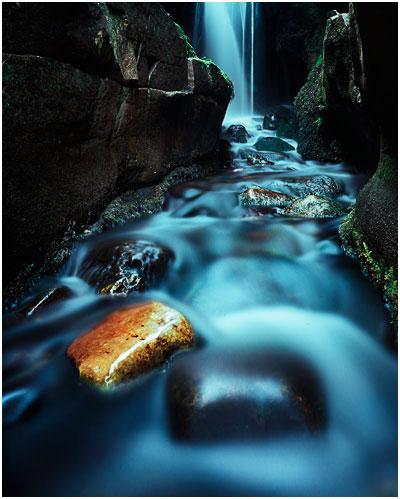
There's this fabulous little canyon on the Isle of Eigg with a waterfall at the back. I take my students on my Eigg workshop to this location, even though it fits only one person at a time because as much as the location is extremely limited (you can't really move much), you'd think there's only really one shot to be made in here. But last September, I 'captured' Iain on my workshop in here. I'd been trying to catch up with Iain, but felt he was a little too shy to spend time with me. So I managed to corner him in this little canyon and we spent maybe 20 minutes working on a shot similar to this one (my shot was taken after Iain had finished making his).

I loved my little 20 minutes with Iain here, because it was one of those moments where there's really something to impart. A very clear message can be reached.

We started off by making very general images of the canyon but I'd noticed that further inside there was this beautiful sandy coloured warm looking rock. It seemed to be shouting out to me - 'I'm here - take a picture of me!'. The reason why it stood out so much was that it's colour was very much outside the palette of every other rock there. I felt it would make a very strong compositional element - it would be the focal point of the shot if we used it correctly.

I know that Iain got a lot out of this little bit of time together as he thanked me and said it had been really useful. I was just so delighted that on all my times in this little canyon, a golden rock had surfaced and was so much there on it's own, it was a great feature (or device) to use in a composition.

I think Iain had said to me that he hadn't noticed it when we'd gone into the canyon, but it was, for me, perhaps the one thing that jumped out. I think there are two lessons here - exploring a location, even one as tiny as this can help you find things you never saw upon first encounter, and your final images may be stronger as a result. The second lesson is perhaps to realise that repeating the same location on different trips may yield new insights, new finds. I've certainly never seen that stand-out rock before.

I think I've taught myself over the years to think about 'separation'. Looking for objects in a scene that have a presence, either because of the light that is being cast upon them, or more unusually, because their colour makes them stand out a bit more.

I'm looking forward to going back to Eigg this September.

Storm over the isle of Rum

Back to that 'essence' topic again. As I work through the bunch of transparencies lying around, i'm aware that I just seem to be interested in those which impart a sense of mood and that have an 'elemental' aspect to them.

I do a couple of workshops on the Isle of Eigg each year, because I feel it's a great place to study the same landscape time and time again.

What I've noticed over the last three years of visiting Eigg, is how the light changes so rapidly there. Mood and drama come and go so quickly. It's very hard to impart that with a wide angle lens sometimes. The isle of Rum is a big presence on the landscape and often the mood and changing light happens in and around the Cuillin ridges of this mountainous island. I've just never really managed to capture it because it's so easy to go wide angle all the time.

Well this shot was a deliberate effort on my part to look beyond the immediate beach, and take advantage of the rain in the distance.

Rain is a beautiful thing. It's atmospheric properties can't be overstated I feel. Rain can be used to veil subjects - to conceal them, turning them into opaque tones of mystery.

They have a saying on the isle of Eigg.

"If you can't see Rum, it's because it's raining, and if you can, it's because it's not raining - yet'.

That's one of the many reasons why I love Scotland's landscape. It's moody, it's changeable, it makes for surprising gifts in the way of fleeting light. It's also a challenge at times, and when things do conspire to provide a beautiful moment, the moment is more enjoyable because you know, deep down, that it's rare and something to be absorbed and enjoyed greatly.

Looking for the essence (part 3)

A few days ago I titled a blog entry 'finding the essence'. I felt the title was apt at the time because my posting was about objectivity. When reviewing your own images after a shoot, being able to see the essence or beauty that is there, rather than being blinded by a desire to see what we wished the image to be.

Well, I've been thinking about the word 'essence' and also the particular image of Harris I showed on the blog in that particular posting.

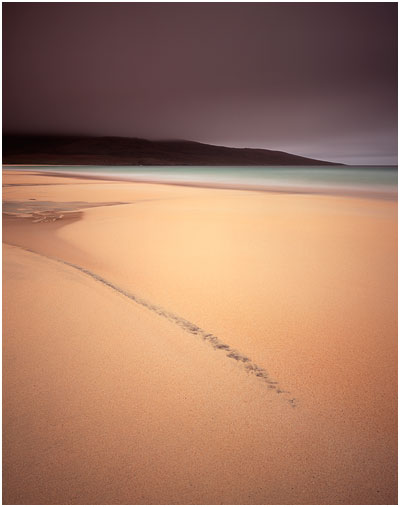
I responded to that image of Harris (reproduced here - image #1), because there's a lot of harmony going on in it for me. The tones really resonated with me and I also felt the composition was very simple too. When these two elements are married together, often the resulting image seems to be a more powerful statement. I think this image works so well for me because the 'essence' of the landscape has been conveyed very clearly - the message is strong.

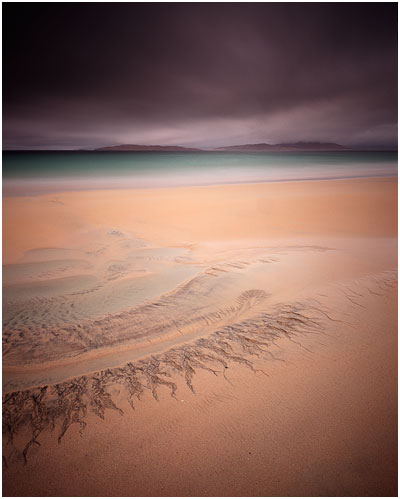
Compare image #2 that you see further on in this post. It's got similar light, and was shot on the same evening. Except I think this image does not work so well. It's missing that extra 'something'. I think it's failed to reveal the 'essence' of the landscape.

I often feel that simplification is a complex thing to pull off. What looks simple is often harder than it appears. Landscape images for me, must contain a soul, they must resonate with you on an emotional level, and breaking things down to colour, tone and form is the best way forward to make images that do that.

Image #2 is too clever. There's too much going on in it, even though there's not that much at all in the shot. But things are competing with each other. There's perhaps too much texture in that sky to sit in the background and let the eye fall on the patterns in the sand in the foreground. It feels as if I've put the wrong sky in with the wrong foreground. Both are not working in harmony.

Image #1 on the other hand is a different case. That sky sets a mood, but there's almost no texture in it. That lack of texture complements the lack of texture in the sand in the foreground. It is as if the sky and ground are working together - a form of visual empathy. And then we have that diagonal streak in the sand. It's allowed to be the focal point of the image and everything else around it is there to support it - not take away from it.

As much as I've tried to explain the images, and get you to think about why one works better than the other, I don't think there's such a thing as a rule book, and I have to confess that although image #1 is my favourite - it was a complete surprise to see it in my processed transparencies. In other words - I did not plan it. And i don't think I could have.

That's what I love about photography. It's those surprise elements. You only know what it was that you were looking for, once you've found it. That was certainly the case with this image.

Looking for the 'essence' part 2

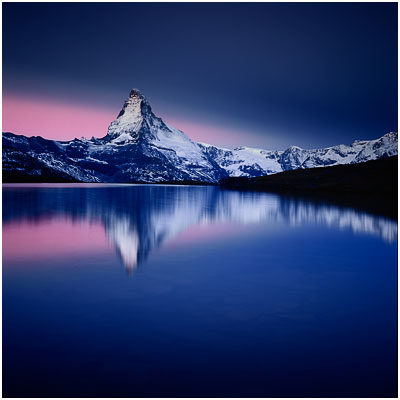
Following on from yesterday's post, I'm still messing around, looking through the batch of transparencies I have had lying around for the past six month, or in the case of this image of the Matterhorn in Switzerland - since last October (Sonja - is that right?). I knew I'd got some nice shots of the Matterhorn, because the light on both mornings that we were up there was something else all together. Very stunning light - the kind of light that Galen Rowell would capture and I would wish to get too. I love how the sun is just hitting the tip of the mountain in this shot.

I also remember making some Lummix GF1 'notes', as I don't really feel much of a bond for digital images right now. I do think that will change over time, but right now, I'm still very much in love with Velvia, despite that I seem to have been going for a more muted colour palette the past year or so. So it's also of great delight for me to feel I've reconnected with that wow factor that Velvia provides.

However, this post is really about how I managed to let an image like this sit in a folder for months on end. As I explained yesterday, I didn't feel like doing any scanning. I didn't feel like doing much of anything to do with photography in my spare time, and I knew, just as I did when I came home from India in 2009, that I needed some distance and to rest.

I've had a really great time of late. The trips to Patagonia and Bolivia were simply incredible. Great company and great light, and I was also able to shoot some of my own images too during the trips. I've been resting for the past two weeks because it's been an extremely busy year for me. I haven't really slowed down.

But today I felt like I was in the right mood and frame of mind to look at the images.

It's all about timing. If you've got a good image - it's not going to run away. I sometimes feel we're worried that if we don't edit as soon as we get home, then the image is going to disappear in a puff of smoke. It simply isn't true (unless you format your memory card, or lose your unprocessed films!). But on the contrary, editing so quickly after the shoot, can lead you to lose the image for sure. That lack of objectivity can wreak havoc with your judgement. In order to see how things really are, and to not force something to be what it may not be, you need distance. A bad memory helps also (I don't think my memory is so good these days). I can often forget that I'd even taken an image. So when I see them, it's like I'm seeing them for the first time. I'm sure that's a great benefit to accepting them as they are.

Further, I'm not one for the 'single shot'. I much prefer to work on images that are related to each other, and that can sit together to form a body of work. That to me is very inspiring as I feel the portfolio is a whole story that is slowly unraveled as each image is worked on and added to the whole. But over the past two days, I've found relief in the 'single image'. I guess it's because there's less pressure for it to stand up to existing in a set of images, and there's no worry about whether that set or portfolio is going to work together as a cohesive work. The pressure is off, or the feeling of having a lot of work in front of me has gone. Things are simpler dealing with an image and enjoying it for what it is, rather than how it will co-exist with other images in a set.

This has surprised me greatly. I guess these little one-off's are a delight to me, as I'm just in the mood to work on small units rather than a big portfolio right now. Hopefully, this is gearing me up for working on my Easter Island, Patagonia and Bolivia shots in a few weeks time.

Interesting times ahead.

Looking for the 'essence'?

I've been saying for a while, that I really hate to charge in there and edit images as soon as I've made them. I've learned over the past decade that giving myself some time and distance between the shoot and the edit, has helped me be more objective about what it was that I captured. I also feel I'm able to get more out of my editing than I would have if I came home and worked on them right away. It's that proverb about not seeing the wood for the trees. With a little bit of distance, I can see more clearly what the actual image 'is', rather than be caught up with trying to force the image to fit what I thought it 'was'.

I've had a back log of images sitting in a little folder on my desk for about six months or maybe more now. When you run a workshop business, you spend a lot of your time with the clients and very little time on your own work. I perhaps maybe shoot as much stuff as I did, when I was not  full-time. Anyway, I did look at the contents of the folder several months ago, and felt I didn't have any enthusiasm to work on anything contained inside. I think at the time I felt there was really nothing there, but I was also aware that I was feeling a bit tired anyway. So on a hunch, I left the folder in my 'to do' box. I guess I knew I wasn't really ready to approach looking at any images and doing any editing.

So today I found myself just opening up the folder and finding all these beautiful images in there. I'm a bit dumbstruck as to how I could have left these in there for so long, and more importantly - why did I feel 'nothing' for these several months ago? It's a rhetorical question because I always knew the answer - 'I wasn't ready to work on them'.

I know, it probably sounds a bit 'zen' to you. But I really do feel there is a time and a place for all things to be given attention. I didn't feel it months ago, and I listened to how I was feeling and parked the images to one side. Today is clearly the day where I feel it's the right time to work on them, and I'm very taken with the first image of Harris you see at the top of this post.

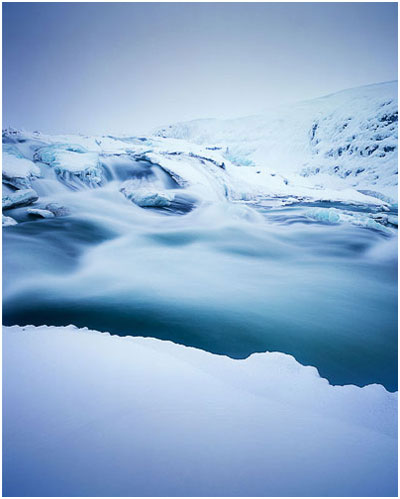
Regardless of whether you can't wait after a shoot or not to work on your images, it's also worth noting that it's good policy to go back and review the negatives months later, because you may see things in there you passed over the first time. That photo fo Gullfoss you see - never made it to my Iceland book. It never even made it to any scanning stage at the time either because I was perhaps too wrapped up in the more obvious things that fitted what I was looking for. I'm sure there are always golden nuggets of images sitting in our previous shoots, ones we passed over, because we were looking for something else.

Months later, I'm free of any preconceived ideas I had. I'm able to just look at the images, very detached from what I was hoping to do during the actual shoot, and I'm able to take them for what they are.

Lenswork Interview

I've just been informed today that the content for my Iceland book - 'a journal of nocturnes' will be featured in this September/October editions of Lenswork Extended.

If you're not familiar with Lenswork, I can't recommend it highly enough. It is perhaps one of the few very high quality photography magazines out there. Run by Brooks Jensen, the slant is very much on black and white photography only, and focusses very much on the artistic side rather than the technical (just fine by me - I get inspiration from enjoying others work, not looking at camera gear). Anyway, Lenswork also covers colour work in their extended edition, which is the place you'll find me, along side an audio interview.

When I have more firm news about this, I'll let you know.

Meanwhile, things are ramping up here at the office in Edinburgh for the release of my 2nd book this November (official release date is now 1st of November). There will be news about advanced orders, including some very special limited edition variants of the book in this months newsletter first, which you can subscribe to on my home page.

Beyond Words 'pop-up shop'

Beyond Words will be holding a temporary shop at Stills Gallery, Cockburn Street, Edinburgh from 2 to 30 August.  If you're going to be in town then, Neil has told me that he will have copies of my book on display, should you wish to have a browse (and hopefully buy a copy or two).

Rauðfossar, Central Iceland

I love to make up stories, whether it's verbally, or visually. Tonight I've just got my 8-rolls of film back from my little jaunt around the central highlands of Iceland over the past two weeks.

There's not much in the rolls of film I came home with. I didn't expect there to be, because I don't think I was operating on full-cylinders for the first week and a half. Partly due to tiredness from all the traveling I've been doing, and also because the weather (Iceland had been having a terrific summer up until I arrived), was pretty miserable and lacking colour most days.

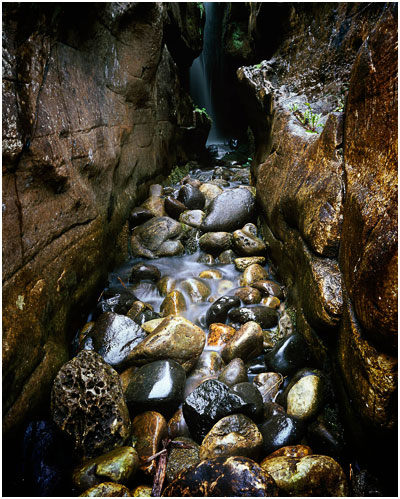
Until that is, I visited Rauðfossar waterfall in the Rauðfossafjöll range (central highlands). It came at the very end of my trip, and talking to a friend of mine about the experiences, she said to me 'it seems you enjoyed your last week in iceland, and I'm sure you'll look back on it fondly'. Well, I guess that's very true, as I'm particularly happy with these three images (or stories as I like to think of them, because I feel they illustrate some aspects of Rauðfossar's character - the waterfall is very difficult to photograph in its entirety, as it's so large and looks like a rather messy spiders web from afar).

But up close, the waterfall is a wonder. There was even a tiny glacier in the river bed (the remnant of last winter, that still hadn't melted away). And although it is called Red falls, it actually has a lot of orange stone in it (the image on the far right has not been messed about with to make that foreground rock look as orange as it is, that's really mostly how it looked + velvia saturation).

This has been a place I've been trying to get to for the past eight years. I'm surprised that it is not on some central highland-tour stop. None of the buses stop here, there isn't a campsite at the base of the falls (I have an epic tale to tell of how I managed to get here), and it's not even featured on most of the postcards you see in Iceland. In short, unless you're really into studying Iceland a bit more than the average tourist, you'll probably not know anything about this beautiful place.

Now, in terms of my little epic tale - of how I got here. I'm embarrassed to say that I had to ford three rivers to get here, and maybe walk around eight miles in total. Most of the wardens in Landmannalaugar don't know of it's existence, and it was only by spying a map in a little cafe that I saw the words 'raudafoss' and said - oh - where is that? There seems to be a campsite near by', and before I knew it, I was packing my my tent and heading for a bus that would drop me off at the particular campsite. I still had no idea if I was going to get to this waterfall, but I felt that if I got to the campsite 'near' it, I might get a better informed opinion from the warden there to how it might be possible to get to the waterfall - which is exactly what happened. I was informed upon arrival at the new campsite that the waterfall was 'just around that bend, maybe 8km away, easy to get to (yeah, right!), and maybe a little stream to cross (yeah, right - ha ha ha).

I made it to the waterfalls around 9pm after crossing three rivers, some large expanses of moss and not another person to be seen for miles. I also add that on my return just after midnight, I had to cross the same river (almost waist-level in places) without my trousers on and boots held high in the air (as well as camera bag), and me cursing myself for being so daft to get myself into this situation (the amount of times I get myself into stupid situations for the love of a landscape photograph).

I got back to my tent near 1am, dirty - the river was full of black sand and silt. But happy, because I knew that I'd finally made it to the waterfall I've been so wanting to visit for years.

Madness, but then again, isn't that what all landscape photographers are?

In terms of compositional information.I seemed to be attracted to rocks that had a degree of separation from their surroundings. Either in space (solitary rocks), or more often in terms of tonality. Playing in a landscape like this almost felt like I'd been let loose in a sweetie-shop (candy store). It felt like it was easy pickings to go find a rock that stood out - some were yellow-gold, and others were bright orange. It would be a great place to teach people about composition from the point of view of using colour and space for separation.

(ps, if you click on the image - you'll see a nice big jpeg of the three images of the waterfall).