The economics of tripod sizes

When you travel, do you cut back on the size of tripod you can take with you? Do you leave behind your most flexible, sturdy tripod, in exchange for one that is more flimsy, lighter, and less flexible?

I can appreciate there are times when a lighter tripod is the only way forward. You are going trekking, or there is some physical limitation to the tour you are on which means a bigger sturdier tripod is impractical. But flight baggage restrictions shouldn’t be one of the reasons why you leave your most sturdy, and perhaps tallest tripod behind, and turn up with a more limited option.

My tripod is the one on the far right. It may seem overkill, and I may not use it’s full height all the time, but when I do need it, I’m really glad I have it. Especially when I’ve spent $$$ to go somewhere. Getting the photos I want is important an…

My tripod is the one on the far right. It may seem overkill, and I may not use it’s full height all the time, but when I do need it, I’m really glad I have it. Especially when I’ve spent $$$ to go somewhere. Getting the photos I want is important and limiting myself by using a more limited tripod makes no sense, unless weight is an absolute critical issue for you.

For me, having a really tall tripod is critical. Cut back on the height and you cut back on your options.

Let’s think about this. When we travel, we travel to make photographs. So our no.1 concern should be to have the best tools with us. Cutting back on you tripod due to weight restrictions means you are cutting back on your photographic options. I’d argue that you can get that tall tripod in your luggage, and that you can carry it along with your other luggage, if you’re just more selective about bringing what you really need, rather than all the other things that you hardly use at all.

You are traveling to make pictures, and a tripod is essential in allowing you to get the best pictures you can. One of the best choices of tripod for me has been to bring one that allows me to extend it higher than my own physical height.

If you’re wondering why I need a tripod that goes up to 9 feet in height, then read this old post about tripod choice. I explain why having a tripod higher than you are is a very flexible, and important decision to consider when buying a tripod.

I’m in south Korea right now, and I’ve brought along the tallest tripod from Gitzo. It has a maximum height of 9 feet, and so far, I’ve used it at full height due to some walls and barriers that I’ve had to work around. This would not have been possible if I’d opted to bring along a lighter, more economical tripod.

I just think it makes no sense to cut back on your tripod and choose something lighter, when the main reason why you are travelling is to photograph. Your tripod should be the first priority when thinking of packing your bag. If the bag isn’t big enough for a solid tripod, then get a bigger bag. If the weight of your luggage exceeds the restrictions, then keep the tripod in, but lose some other things that are non-essential.

The last thing you need, is to find that you’ve spent thousands of dollars going on a trip of a life time, only to find that you can’t quite get the shots you want, because your tripod just needed to be a few feet higher, or more sturdy in some windy places.

The tripod I am travelling with right now is the Gitzo Systematic Tripod Series 5 6S G. I’m loving it and I don’t intend to go back to a smaller, lighter one, unless it is for practical reasons such as trekking long distances etc.

Scars on land

What is a landscape, other than scarified lines and mutable elements?

What if the sea is nothing but texture, like rough concrete? A place that your eye feels a dryness as it moves across the page.

What if the land is nothing but scarifications, fractures and abrasions? The land itself has become un-land, and is nothing but difficult textures and rough edges?

Abrasive places have beauty as much as any traditional landscape. What one may define as ‘quarry’ in an attempt to convey a sense of ugliness and deem a place as un-beautiful, lacks the comprehension that landscapes, even difficult ones, are beautiful.

Fjallaback-Sept-2018-(27).jpg

It ended far too soon......

I love it when song’s don’t overstay their welcome, and actually end before they are over.

I think JDFR is a bit of a waking talent. She’s around 24 right now. Another reason why I think Iceland is such a cool place. It seems to be a hotbed of talent. Perhaps it’s to do with 1 degree of separation, rather than the usual 6º degrees. There are only 330,000 people on the island. But that would be to detract from JFDR’s talent. She’s talented for sure.

Bhutan portraits 2016

I’ve just gone through the rolls of film from my shoot in Bhutan in 2016. They’ve been sitting in a ‘to do’ list for over two years. I think, sometimes I really need distance from a shoot, plus I have a lot of other things on. This is no longer unusual for me to sit on images for so long. I have other images from other shoots that are sitting patiently for when I feel I’m ready to work with them.

One of the delights about this trip, was being able to get behind the scenes access. I can only thank Ewen Bell for assisting in this. I joined Ewen’s tour in Bhutan, which I thought was amazingly well organised. So much research and time he must have spent, and he has great relationships with the people he works with in Bhutan, so I think this was all a matter of trust that was bestowed upon us.

I can’t say I’m a brilliant portrait shooter. In fact, I was overcome with a lack of confidence at the start of the trip and it took me a week or so to get comfortable. Somehow, I just didn’t have the courage to approach people. This does happen to me from time to time.

I’m always left wondering why landscape shooters don’t enjoy portraiture. To me, people are much more dynamic but ultimately, a good portrait shot is like a good landscape shot : they both contain a good composition, good colour and tonal relationships and of course, soul.

Portraiture is harder work for me. I know my real forte is landscape work, but that doesn’t or shouldn’t mean that it’s all I should do. I get immense pleasure out of meeting people, the interaction making pictures of them, and it adds another dimension to my photographic life.

The biggest technical challenge for me was shooting in such low light. I’m a film photographer and the highest film speed I can travel with is 800 ISO. It’s simply not fast enough for many of the interior locations I was in. I pre-empted this with taking along a monopod, but still, shooting wide open at f2, and finding the camera telling me I have a shutter speed of 1/4 second isn’t ideal….. I was frustrated.

I also got some x-ray damage on some of the rolls of film, despite having a lead bag to travel home with the films. I don’t believe in the myth that X-ray operators turn up the x-ray if they can’t see inside the bag - it makes more sense to me that they will just stop the bag and have it searched, and that the x-ray machine would be set to a fix dosage. So I think that all that’s happened is that some of my films weren’t in the lead bag - maybe still in the film magazine of my Contax 645 camera. Anyway, it’s only about 2% of the films that were damaged, and even then, it was a slight oscillation throughout the film and hardly detectable at times.

But I do wonder about shooting digital for these kinds of interior shots. High ISO digital capture is so good now. However, I just don’t like the ‘look’ of digital. There’s a depth and intensity to the colours of film that I don’t see in digital work, but perhaps that’s all in my mind. Who knows?

If you’ve never given portraiture a chance, then you should. The hardest part is asking, and the second hardest part is staying with your subject and directing them if need be.

Bhutan-2016-(13).jpg

Bhutan

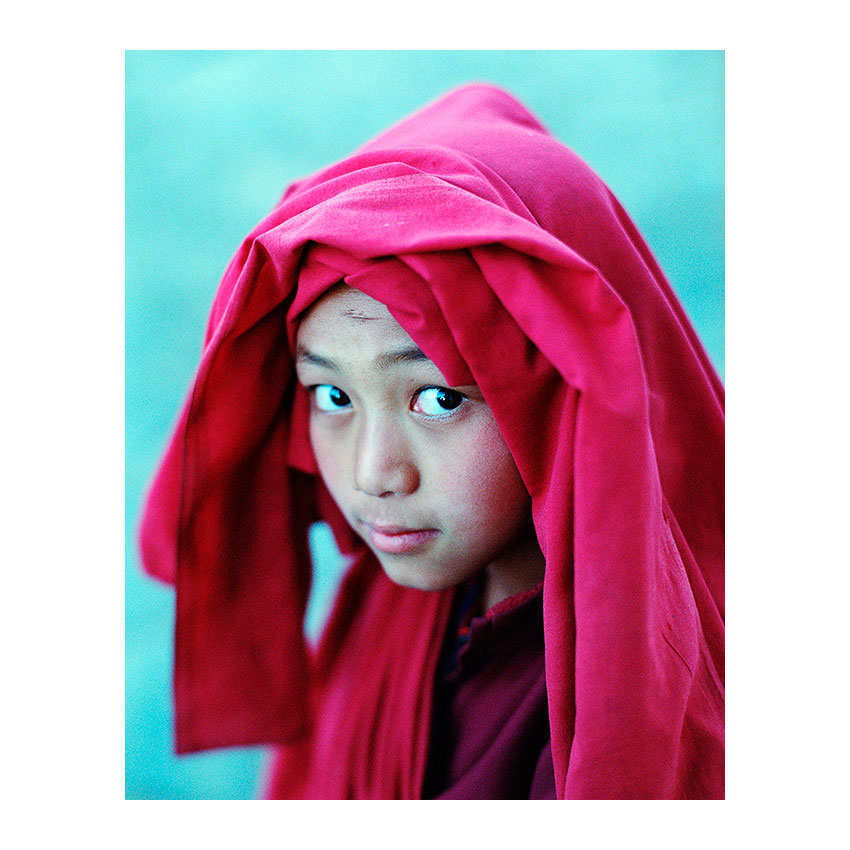
I haven’t made portraits in a while ( about two years ). I’m just going through some images I made in Bhutan back then, and although I’m pleased with the images I’ve uncovered so far, nne of them come up to this little gem that I’ve just uncovered night.

Bhutan=2016-(7).jpg

The thing is, I have absolutely no memory of taking this shot. Which goes very much against what I often tell people - that the good images often burn themselves into my mind. I simply cannot remember it, and so I think it must have been so quickly made. Perhaps a second or two encounter. Gone in an instant.

I really like this shot - the background colour compliments the red robe of the young monk, and of course, the way he is wearing part of his robe on his head and looking at me just works so well.

I haven’t gone through all the films I shot so far, but I can’t help but feel this might be the best shot I’ve made out of my Bhutan collection.

Old meets new

I was in Bhutan two years ago. I’ve only just gotten round to looking at the films from this trip.

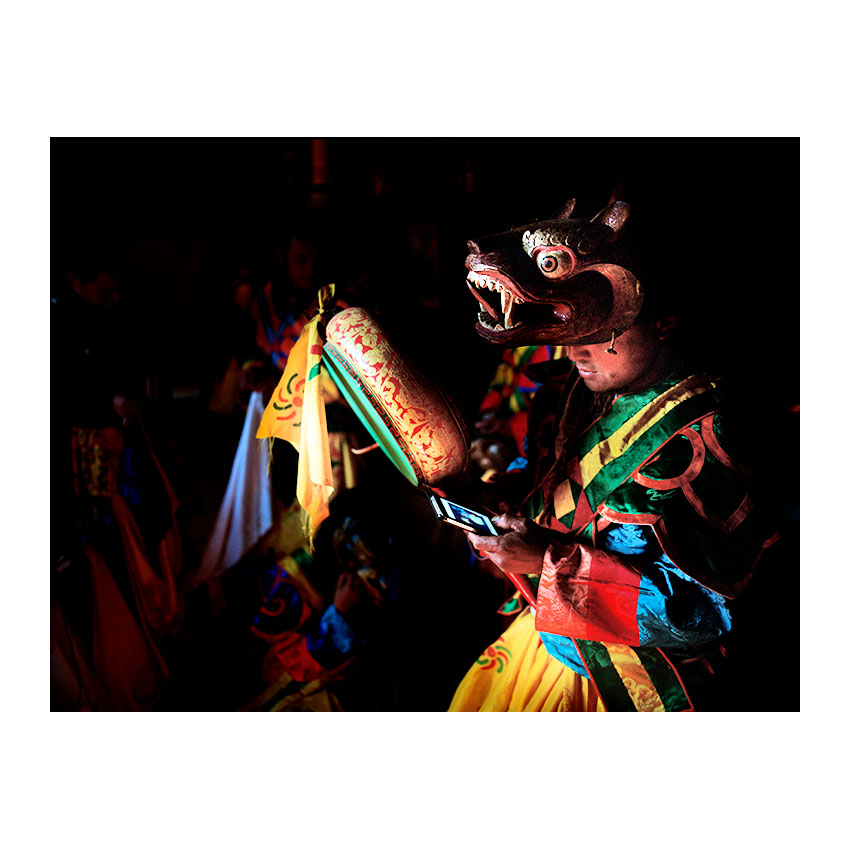
As part of the trip, I was able to get access ‘behind the scenes’ to some of the quarters where the dancers were getting dressed.

I wasn’t aware of it at the time, and I’m so surprised to note that one of the Bhutanese dancers is busy checking his mobile phone while he is preparing to dress for the festival. I simply didn’t spot it at the time I was making the photos. Part of getting on with the chaos that was around me at the time of the shoot.

Image-1.jpg
Bhutan-2016-(16).jpg
Bhutan-2016-(15).jpg

Portraits

It’s been a while since I photographed people.

I love making portraits! They are ‘landscapes of the human soul’.

For me, Portraiture is a real break from shooting landscapes.

Perhaps it’s time for a change :-)

Anonymous, Vague, Undefined

If a photograph spells everything out for you, then as a viewer, there is no room for your own interpretation.

As photographers, we all want to convey a point of view. If we have several photographers at the same location, it is fair to assume that each one wishes to convey their own story. Their own point of view of the same landscape.

Fjallabak-Winter-2018-(19).jpg

Which leads on to my argument today.

If each photographer wishes to convey his own interpretation of the landscape, then surely it’s fair to assume that any viewers of your work may wish to have ‘room’ or ‘scope’ to create their own interpretation of what you shot?

The answer is clearly yes, because even if you wish to convey a particular point of view, you can’t control how other people think. You can just invite them to think along the lines you were hoping for, but even then, you will find that everyone will see different things in your photographs. I know this for sure, because I’ve had 9 years of people telling me all sorts of things about my photographs.

To create work in the hope that others will see exactly what you saw, is impossible. So you better get used to the fact that others see what they want to see.

And if this is true, then why should we be so specific with our work? What I mean is - if everyone is going to interpret your work in a multitude of ways, why bother trying to be specific? Why not instead, deliberately make photographs that are so vague, that you are deliberately inviting others to interpret them?

Let’s look at an analogy of this.

In the movie industry we can boil images down to two types of film:

  1. One where there is no room for interpretation. They explain the plot to you and force you to see it their way.

  2. One where there is no explanation. No actor at the end of the film explaining to you what happened, and why it happened. You are left completely, deliberately in the dark.

Point 2 : these are my favourite films. I am left to wonder, to try to piece together what happened and to reach my own conclusions.

I think these kinds of films are much much more engaging, and thought provoking.

So if that is true with movies, surely it is the same for photographs? I think so.

Often I find participants on workshops trying to emphasise something - they want to make a particular aspect of the landscape stronger. This is fine. I accept this. But sometimes the elements in the landscape we want to emphasise are already clearly visible. It’s just that we lack the confidence to realise any viewer of our work can ‘get it’. So we tent to try to spell these aspects out to them.

I think photographs where you’re not quite sure where the dividing lines are, where earth meets sky, where night ends and day begins are compelling. They invite me to form my own opinion because the photographer has clearly hidden any intention. You have nothing but your own thoughts to decide what the photograph is all about.

That is why, I think I love to work with snow and black deserts. They often hide aspects of the landscape that explain where we are, what it is we are looking at. With snow, it is easy to dissolve the line between sky and ground. To force the viewer to see their own horizon, or to assume there is none.

Foggy days are perfect for this. Anything that invites confusion, or for the viewer to work harder at figuring out what is going on, is, in my book, a great thing.

Eldfjall

There shouldn’t be any boundaries in photography.

Regardless of my own ‘religion’ of what I think ‘is’ and perhaps more specifically ‘what isn’t’ photography, my own views are just that - my own views.

Eldfjall, black lines and forms

Eldfjall, black lines and forms

I’m well beyond the point of feeling I need to convince others that my view is the only view to have. I think photography is still very much an emerging art. It’s still relatively speaking a very young art form. If you consider it an art-form that is.

You need to find out for yourself what photography means to you, and where the boundaries lie. Perhaps you love HDR, perhaps you hate it. Perhaps you think photographs shouldn’t be altered once the shutter has clicked, perhaps you think it’s only the beginning….. whatever you choose - it’s your prerogative.

For me, the boundaries have become blurred. Graphic art overlaps into photography and photography overlaps into graphic art.

nostalgia

A feeling of nostalgia is hitting me tonight.

As I sit here, after spending the whole week preparing copies of my Altiplano book to be shipped out, I can’t help reflect upon the journeys I’ve made over the past decade or so.

I’ve said many times, that the time we spend outside making images, is a way of us marking our time. Photography gives us a great chance to stop and think about where we are ‘right now’, and then as time goes on, we can look back at images we created and they bring us right back to that moment.

altiplano-books.jpg

Who we were, what was going on in our lives. Photography gives us a chance to not only relive the past, but also to draw contrasts with where we are now, who we are now, and how we’ve changed.

I can’t think of a better way of marking my time. Photography has given me a way of remembering the past, and of noting just how much I’ve done with my life.

And for that: I can’t help but feel rather nostalgic tonight.

I’m not entirely at ease with the emotion. I think nostalgia is sort of interlaced with a sense of loss. I think that’s ok though. Isn’t it? We must all accept that what water has passed under the bridge won’t return. What we experienced, what we felt and saw, happens only once.

For me, I think the feeling of nostalgia tells me one thing: to cherish every. single. moment. Who we are, are our memories. We are the culmination of everything that went before us. To revel in what we did, where we were, who we were, what we were doing, is such a precious gift.

Great times are often happening right now, except we lack the foresight to know it. You may be forming some of your most precious memories this year, except you won’t know it until much later on in life.

Well, I digress….. but it does have a point. I can’t help thinking about the amateur photographer I was, with a few friends around me who said ‘you should go pro’ (Don’t all friends tell you that?). Except I was daft (stupid) enough to believe. it. It hasn’t been easy, but it’s also been the best thing I ever did.

My Altplano book wouldn’t have happened without the past. I needed to go create some memories, and I needed to go and live. I went to the Altiplano of Argentina, Bolivia and Chile several times, so much so that I can mark my life by it. I know where I was in 2009, 2012, 2013, 2015 and 2016.

My Altiplano book couldn’t have happened without the culmination of experiences. As I said a few days ago, you don’t create work by watching YouTube tutorials, or by reading loads of blogs. You create work by finding out who you are. And to do that, you need to go explore.

That’s exactly what I did. I went exploring.

My Altiplano book couldn’t have happened any other way. And looking back, I realise it’s given me more than just a nice book, and some nice images: It gave me some special memories and markers for my life.

Nostalgia. Well, sometimes it serves us well :-)